Automating the Design of an Entire Bracket Family: How Thales Alenia Space and CDS Accelerated 2x the Full Workflow
.avif)
The Part
An antenna reflector tripod bracket family for satellite payloads at Thales Alenia Space, covering 80+ geometric variants across programs, missions, and antenna architectures. Each tripod must remain below 250 g, meet stiffness requirements equal to or exceeding legacy components, and comply with additive manufacturing or CNC machining constraints across titanium and aluminum material routes. Although all variants share identical functional requirements and load cases, geometric differences between them had previously prevented any design logic from being reused across the family.
The Challenge
TAS engineers were redesigning 80+ tripod variants independently, each requiring a full CAD modeling, simulation, and manufacturability review cycle. The geometries differed only slightly between programs, but conventional tools provided no mechanism to translate a validated design workflow from one variant to the next, making each iteration a full non-recurring engineering investment.
The team's objective was to automate low-value CAD tasks while simultaneously improving structural performance, meaning the automation had to deliver mass reduction, not just speed.
The Approach
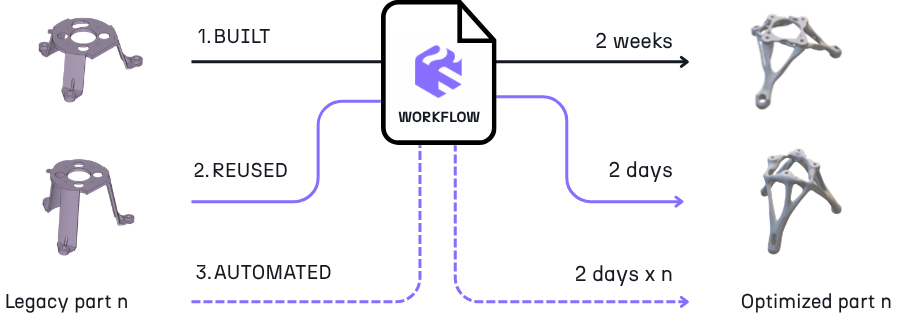
The project followed a two-phase structure: first, a full design exploration on the reference tripod to identify the best-performing configuration across structural, manufacturing, cost, and CO2 criteria; then, conversion of the winning workflow into a parametric template that regenerated each subsequent variant automatically when input geometry was updated. Once built, the per-variant engineering effort dropped from a full redesign cycle to a configuration update.
The case study documents the Design Explorer configuration for the reference tripod exploration, the parametric template architecture, and the variant generation workflow that delivered each subsequent tripod in 2 days.
Key Results
- 45% average mass reduction per tripod versus legacy design baselines
- 50% total lead time reduction across the full 80+ variant family
- 2 days per variant after workflow buildup, versus 2 weeks per variant previously
The case study includes the full Design Explorer KPI tracking setup, the parametric template architecture, and Thales Alenia Space's engineering feedback on the workflow integration.
Why It Matters
Part family engineering changes character when the workflow becomes the reusable asset rather than the geometry. TAS's project demonstrates that at scale, the combination of mass reduction and lead time compression is not a trade-off: it is the expected outcome when automation replaces manual variant-by-variant redesign.
Download the case study to see the parametric workflow architecture, the Design Explorer configuration, and the full family results across all 80+ tripod variants.

Interested in reading the full case study?
Fill in the form below to instantly receive the full case study.
Aeronautics Challenges We Address



FAQs
Explore our frequently asked questions to understand how our software can benefit you.
Thales Alenia Space implemented a single parametric workflow in Cognitive Design covering topology optimization, simulation-driven design, and manufacturability analysis for their full antenna reflector tripod family. A single workflow, reconfigured with a geometry swap for each variant, automated the full CAD-simulation-manufacturability cycle, delivering a 50% reduction in total lead time across the 80+ variant family.
Relative to legacy tripod designs, Thales Alenia Space achieved an average 45% mass reduction per part across the full antenna reflector bracket family. In space applications, this level of weight reduction has a direct impact on satellite payload capacity, launch cost allocation, and mission performance budgets.
After identifying the most promising iteration, Thales Alenia Space and CDS teams were able to design each tripod variant in 2 days, compared to the initial 2 weeks per variant using conventional workflows. This 7x per-variant acceleration, combined with a fully reusable parametric workflow, fundamentally changed the economics of the entire program.
Cognitive Design's node-based parametric workflow architecture allows engineering teams to define a single design chain, then regenerate the full optimization, simulation, and manufacturability pipeline for any new variant by modifying input geometry and boundary conditions. This makes the workflow fully reusable across part families without rebuilding the optimization logic from scratch.
Following the project, Thales Alenia Space's Technology and Innovation Lead indicated that results were highly promising and signaled a meaningful evolution in their engineering approach, with integration into their standard design toolchain as a next step. This reflects the platform's readiness for enterprise-scale deployment in regulated aerospace programs with high part-family volume and strict structural performance requirements.
Automotive Challenges We Address



Defense Challenges We Address

Built for the Cognitive Era of Engineering
Shorten product development cycle from the earliest concept phase.
Product engineering cycle
Product engineering cycle
Reusability of engineering workflows
Unlock Your Design Potential
Request a demo to see how Cognitive Design by CDS can revolutionize your engineering workflow