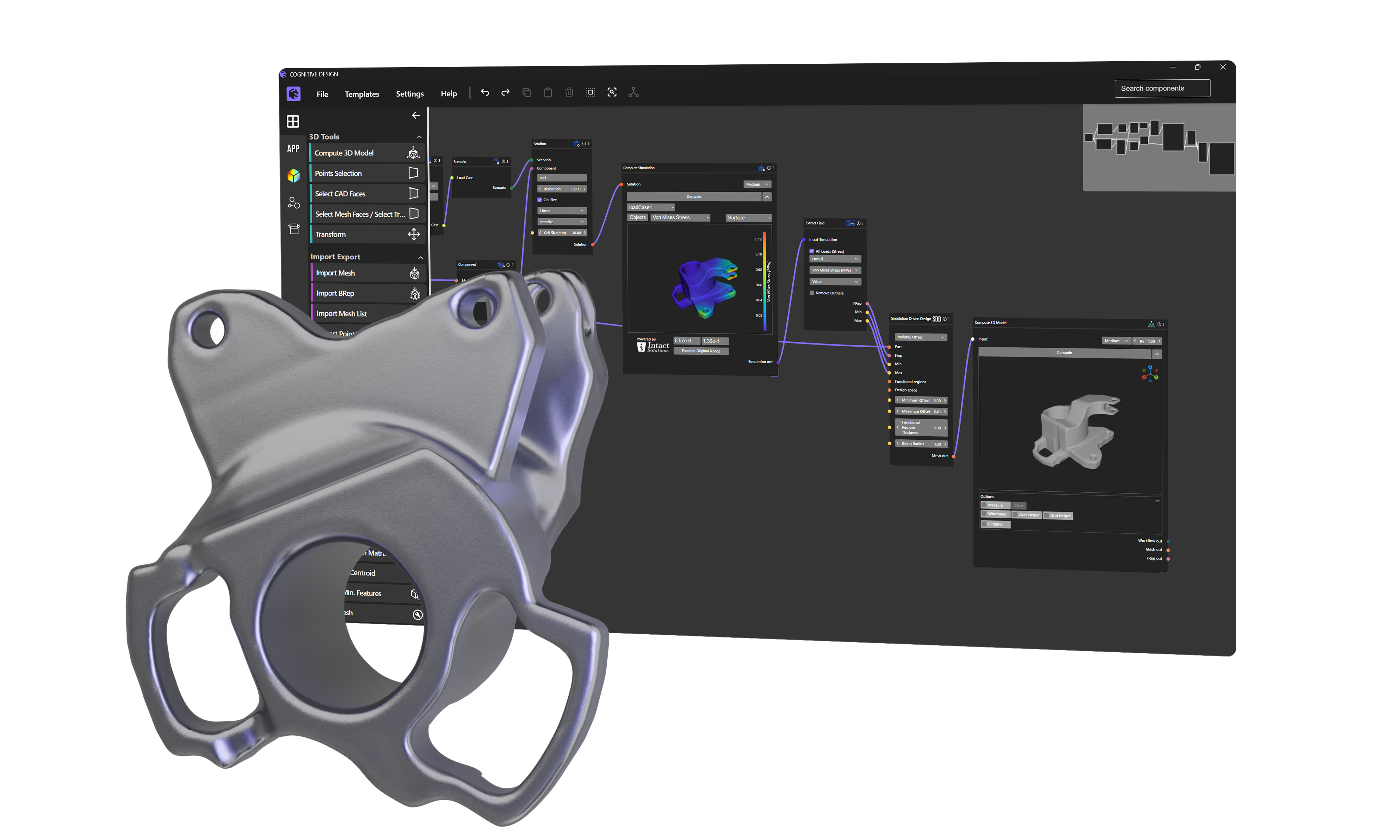
Achieve Unrivalled Performance with Simulation Driven Design
Cognitive Design integrates both structural and thermo-mechanical simulation directly into the concept exploration workflow. Simulation results feed directly back into the geometry: the platform can automatically modify part geometry based on performance data, closing the loop between analysis and design.
Trusted by industry leaders worldwide




Design Efficiency Boost
Cost Savings Achieved
Faster Project Turnaround
Cut Iteration Cycles with Integrated Structural and Thermal Simulation
Both physics run inside the same environment, with the same workflow logic and the same Design Explorer interface. Engineers work across both physics without switching tools, without re-learning a new environment, and without interrupting the exploration loop. From the first concept run, mechanical and thermal results are available side by side, ready to filter, compare, and act on.
Mechanical Simulation
Cognitive Design uses a meshless FEA approach that delivers near-instantaneous structural feedback directly on concept geometry. Unlike traditional FEA tools, there is no meshing step and no model preparation overhead.
Evaluate across multiple design variants within a single session:
- Stress distribution
- Displacement
- Structural stiffness
This makes structural performance a first-class input to the design process rather than a late-stage verification step.
Thermo-Mechanical Simulation
Cognitive Design computes thermal and thermo-mechanical behavior directly on concept geometry, using the same meshless approach as structural simulation.
Track across multiple design variants within a single session:
- Minimum and maximum temperatures from the thermal field
- Heat flux
All without leaving the platform or transferring geometry to an external tool, making it possible to compare how design variants respond to thermal loads before geometry is locked.
.avif)
Automate Targeted Manufacturing - Driven Modification On Your Design


Thanks to Cognitive Design, we were able to rapidly design and validate a structurally optimized tank that fits within our CubeSat constraints, integrates all required functions, and meets demanding pressure requirements. It’s a game-changer for enabling component design exploration high-performance propulsion in small satellite platforms.
Unlock Your Design Potential
Request a demo to see how Cognitive Design by CDS can revolutionize your engineering workflow
Harnessing the Power of Simulation-Driven Design
Our simulation-driven design technology revolutionizes the way engineers approach product development. By integrating advanced modeling techniques, we ensure optimal performance and efficiency.
Seamless Real-World Data Integration
Import mechanical, thermal, or fluid data via simple point maps and simulate real-world conditions early in the design phase.
Constraint-Driven Geometry Adjustments
Automatically adapt geometry to mechanical, thermal, fluid and electromagnetic constraints with precise, simulation-informed updates in real time.
Integrated Generative Design Workflow
Explore and validate multiple design directions faster with direct coupling between simulation and generative tools.
FAQs
Explore our frequently asked questions to understand how our software can benefit you.
Cognitive Design includes extensive material libraries covering metals, polymers, and composites. Engineers can define custom materials with isotropic, anisotropic, or temperature-dependent properties to accurately model real-world material behaviour.
Cognitive Design runs efficiently on standard engineering workstations. The meshless solver is optimised for modern multi-core processors, delivering rapid results without requiring specialised HPC infrastructure for typical concept-phase analyses.
Simulation is embedded within the optimisation loop, evaluating every design iteration automatically. This tight integration enables performance-driven optimisation without manual intervention, accelerating the concept exploration process significantly.
Cognitive Design uses meshless finite element analysis that eliminates traditional meshing steps. The solver leverage the Immersed Method of Moments technology and operates directly on the implicit geometry, providing rapid structural simulation results without mesh quality dependencies or convergence issues.
Integrated meshless simulation eliminates CAD-to-mesh conversion, mesh quality debugging, and result transfer steps. Engineers analyse designs directly, saving 4-8 hours per design iteration compared to traditional FEA workflows.
Cognitive Design exports geometries and load cases for validation in external FEA packages. Engineers can verify critical designs using preferred simulation tools while benefiting from rapid concept exploration within the Cognitive Design environment.
Cognitive Design displays stress, displacement, and temperature contours directly on 3D geometry. Engineers can compare results across design variants side-by-side, identify critical regions, and export visualisations for reports and presentations.
Current simulation capabilities focus on linear analysis suitable for concept-phase engineering. For designs requiring non-linear validation, Cognitive Design exports to external solvers while providing rapid linear screening of design candidates.
.avif)

.avif)

.avif)
