Automotive Upright Lightweighting and Multi-Process Cost Analysis
The Part
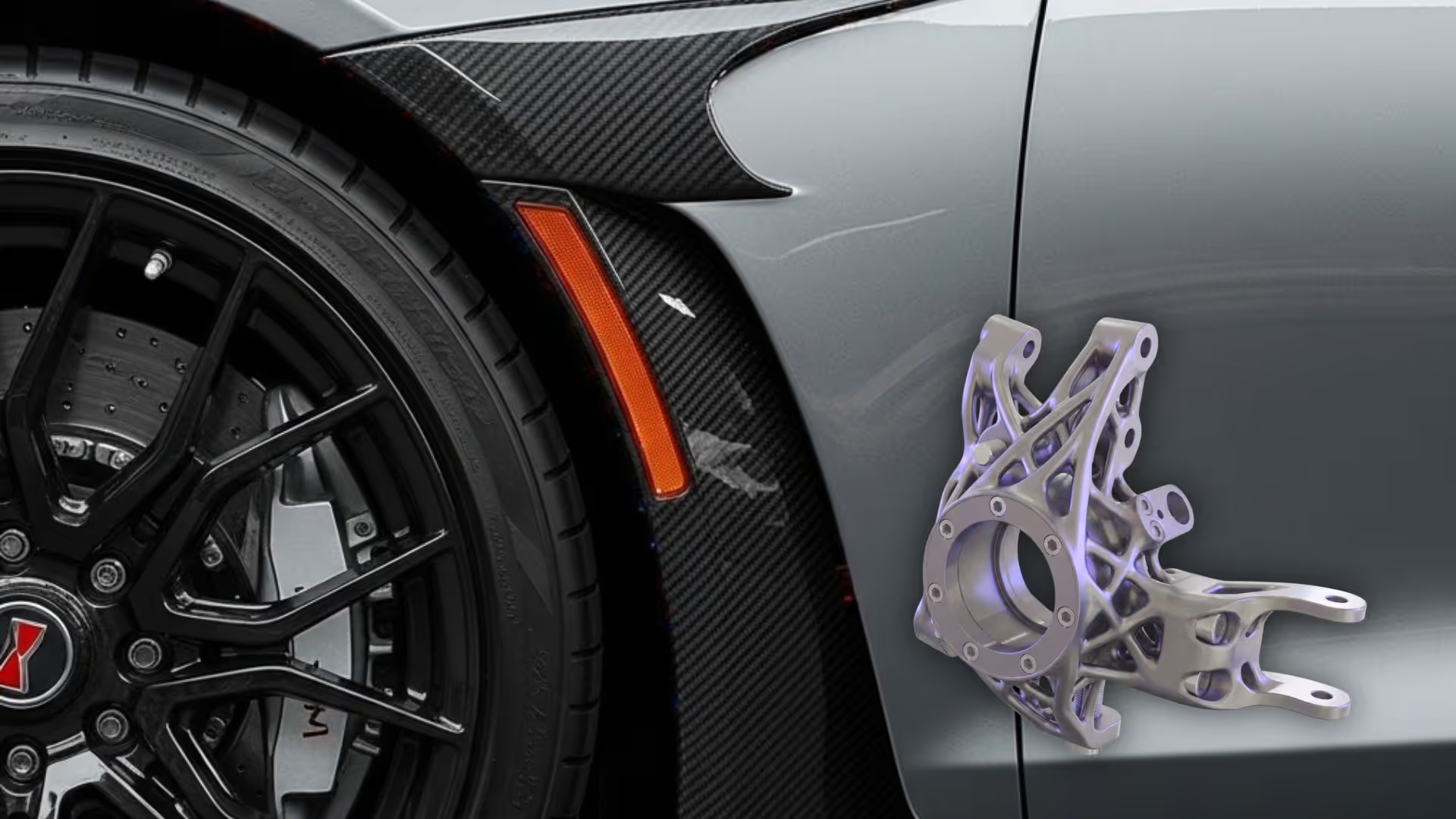
A high-performance automotive suspension upright, carrying the bearing assembly and providing attachment points for calipers, control arms, and the hub. The component operates under compound multi-axial loads during braking, cornering, and bump events simultaneously, making it one of the most demanding structural parts in the unsprung mass budget. The legacy design was machined from steel, resulting in a geometry that was functional but significantly over-engineered for its load environment.
The Challenge
In high-performance and EV platforms, every gram of unsprung mass translates directly into handling response and range. The legacy steel upright carried unnecessary mass that had never been challenged, because evaluating alternative geometries across multiple manufacturing processes was too expensive to do manually.
The engineering team needed a way to compare additive manufacturing, CNC machining, and die casting within a single exploration, including structural validation and cost-performance metrics for each route, without running three separate design programs.
The Approach
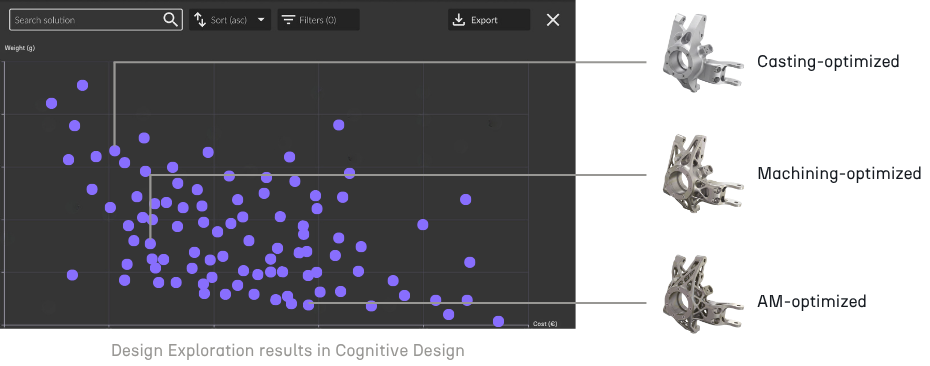
The team generated over 100 design variations in parallel across three distinct manufacturing pathways within a single integrated workflow, with manufacturing constraints, meshless FEA, and cost modeling running concurrently from the first iteration. The result challenged several assumptions made at the project outset about which manufacturing route would deliver the best cost-to-weight outcome.
The case study documents the full exploration setup, the DoE configuration across three processes, and the cost-performance decision matrix that guided the final route selection.
Key Results
- 30% mass reduction on the production design, validated under full multi-axial load cases
- 96 hours reduced to 4 hours of engineering lead time for the full exploration
- Complete cost-performance matrix across AM, CNC, and die casting, delivered before any prototype
The case study includes the full DoE results table, per-route manufacturability analysis, and cost comparison across production volumes.
Why It Matters
When all three manufacturing routes are evaluated simultaneously at concept stage, the decision between them is grounded in quantified engineering data rather than team familiarity. This project demonstrates how that shift changes both the quality and the speed of route selection.
Download the case study to see the full exploration methodology, the cost-performance trade-off matrix, and the multi-process results breakdown.

Interested in reading the full case study?
Fill in the form below to instantly receive the full case study.
Aeronautics Challenges We Address



FAQs
Explore our frequently asked questions to understand how our software can benefit you.
In a documented EV upright lightweighting case, Cognitive Design generated and evaluated over 100 design variations across three manufacturing pathways (additive manufacturing, CNC machining, and die casting) within a single integrated workflow. All variations were evaluated simultaneously against structural performance, cost, and manufacturability, replacing a sequential design-simulate-select cycle.
Cognitive Design compressed upright design exploration and validation from 96 hours with conventional software to just 4 hours, a 96% reduction in engineering lead time. This enables rapid evaluation of over 100 manufacturing-ready variations within a single working session, compared to 2-3 conservative concepts typically explored using traditional CAD/FEA workflows.
The optimized Ti-6Al-4V upright achieved a 30% mass reduction, dropping from 3.20 kg to 2.24 kg, while maintaining structural integrity under critical braking and cornering load cases. For EV applications, reduced unsprung mass directly improves range, handling response, and ride quality across the vehicle platform.
By eliminating traditional tooling requirements for additive manufacturing routes, Cognitive Design reduced production lead time from 8 weeks for cast parts to 5 days for AM-printed components. This acceleration is critical for prototype validation phases, where rapid iteration between design and physical testing is a key competitive differentiator in automotive development programs.
Cognitive Design's Design Explorer automatically calculates and compares unit cost across all manufacturing routes explored within a study, incorporating material cost, machining time, tooling amortization, and production volume inputs. This allows engineering teams to make data-driven manufacturing route decisions at the concept stage, rather than discovering cost implications late in the program.
Automotive Challenges We Address



Defense Challenges We Address


Built for the Cognitive Era of Engineering
Shorten product development cycle from the earliest concept phase.
Product engineering cycle
Product engineering cycle
Reusability of engineering workflows
Unlock Your Design Potential
Request a demo to see how Cognitive Design by CDS can revolutionize your engineering workflow