Copper Cold Plate Optimization for High-Heat-Flux AI Data Center Cooling

The Part
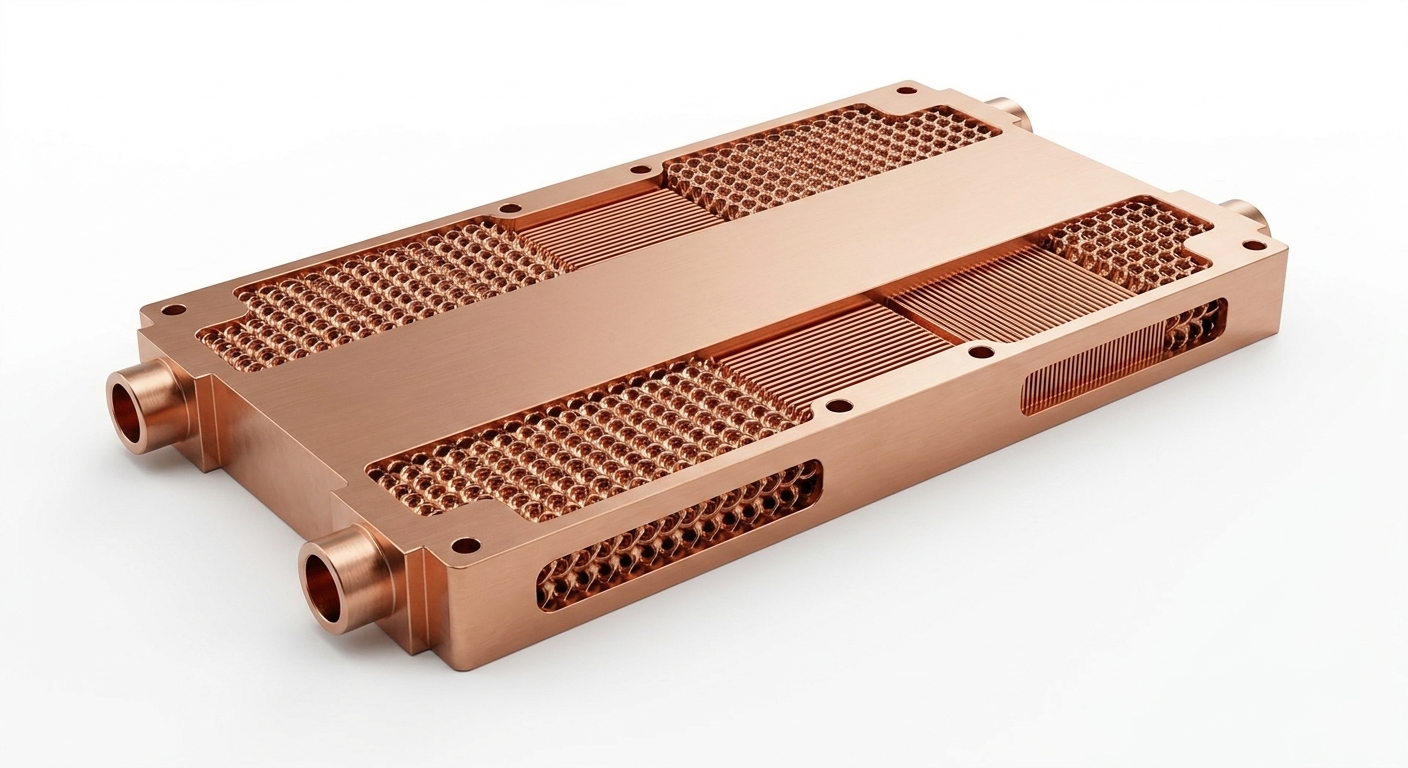
The component is a monolithic pure copper cold plate that sits directly beneath a 900W-class AI accelerator, carrying coolant through internal microchannels, TPMS lattices, and jet impingement structures to pull heat away from the chip surface. It operates inside a liquid cooling loop under a fixed pressure drop budget, running continuously whenever the accelerator is under load. Pure copper was the material of record, chosen for its thermal conductivity and its ability to be built as a single continuous part rather than assembled from multiple machined pieces.
The Challenge
The legacy cold plate, machined or skived copper brazed to a cover plate, was not unreliable. It simply could not keep up with where AI accelerator power was heading. As thermal loads climbed across chip, package, and rack, a uniform channel design left localized hot spots undercooled, and the braze joint at the cover added a long-term leak risk the OEM wanted to eliminate.
The pressure was compounded by time. Redesigning a cooling loop for each new, hotter accelerator generation would normally mean months of requalification, a delay that AI infrastructure buildouts cannot absorb.
The Approach
Instead of scaling a single channel pattern, the engineering team explored dozens of internal lattice geometries in parallel using Cognitive Design, tuning each to the chip's actual heat flux map rather than to a generic thermal load. The manufacturing constraints of pure copper laser powder bed fusion were built into that exploration from the first concept, not checked afterward.
The best-performing geometry was not the densest lattice tested. A jet impingement hybrid with a sparser gyroid structure outperformed denser candidates once pumping power was factored in, a result the team had not expected going in. The full library of variant geometries explored, the manufacturing process window applied to pure copper LPBF, and the complete thermal-fluidic validation data are documented in the case study.
Key Results
- 27% higher thermal dissipation efficiency at equivalent pumping power, versus the machined and brazed baseline
- 60+ design variants explored in parallel across TPMS and jet impingement families, versus 2 to 3 in a conventional workflow
- Engineering lead time cut from 10 weeks to 1.5 weeks for the first validated concept
The case study includes the complete before/after metrics table, the manufacturing process window for pure copper LPBF, and the full thermal-fluidic validation data.
Why It Matters
This case illustrates a broader shift in data center thermal design. As AI accelerator power climbs, the limiting factor is no longer floor space or electrical capacity, it is how much heat a cold plate can move without redesigning the loop around it. Building manufacturing constraints into the geometry from the first concept, rather than validating them afterward, is what makes that headroom achievable on a useful timeline.

Interested in reading the full case study?
Fill in the form below to instantly receive the full case study.
Aeronautics Challenges We Address



FAQs
Explore our frequently asked questions to understand how our software can benefit you.
Generative design and topology optimization frequently produce organic, non-manifold surfaces that break conventional meshing algorithms, forcing manual cleanup that slows down or blocks automated simulation pipelines built around those geometries.
Manufacturing-driven design builds process constraints, such as draft or overhang angles, directly into the exploration phase rather than checking them afterward, which reduces the amount of rework needed once a result is obtained.
Cognitive Design's meshless Simulation-Driven Design extends to thermal-fluidic analysis, and optimized lattice geometries export directly as simulation-ready volumetric meshes, allowing CFD validation in standard CAE environments without manual remeshing.
Pure copper LPBF requires a tightly controlled process window covering minimum wall thickness, powder evacuation paths for internal channels, and laser parameter limits tuned to copper's high reflectivity, all of which must be built into the geometry from the concept stage.
Automotive Challenges We Address



Defense Challenges We Address


Built for the Cognitive Era of Engineering
Shorten product development cycle from the earliest concept phase.
Product engineering cycle
Product engineering cycle
Reusability of engineering workflows
Unlock Your Design Potential
Request a demo to see how Cognitive Design by CDS can revolutionize your engineering workflow