Design Exploration and Automation for Structural Brackets
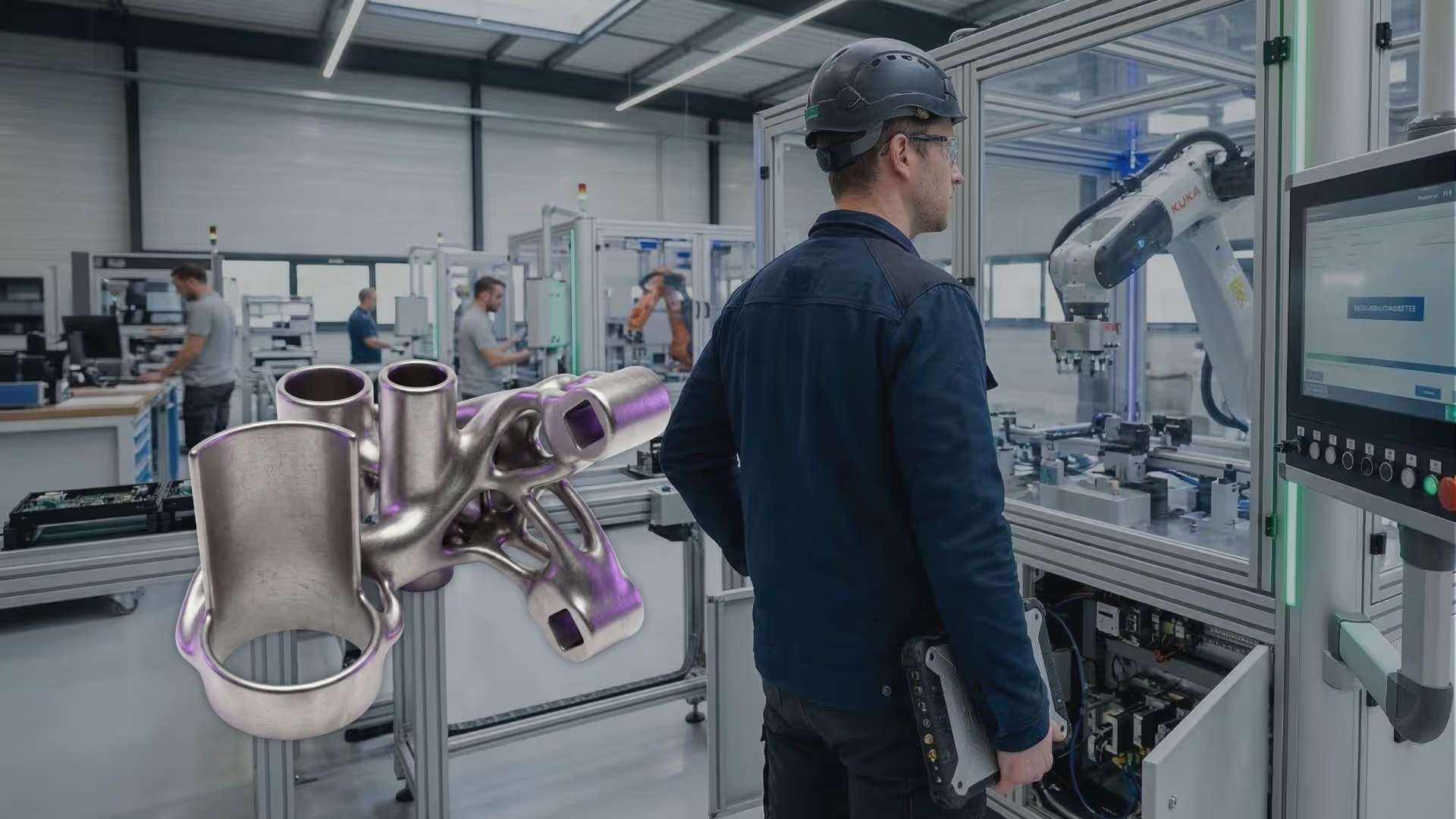
The Part
A family of structural aluminum brackets for a commercial aircraft supplier, each carrying distributed loads across multiple attachment interfaces. The brackets share a common geometric logic across the family but differ in interface geometry, station spacing, and load magnitude, meaning each variant previously required a full independent engineering cycle: CAD modeling, FEA validation, and manufacturing review for additive manufacturing, die casting, and CNC machining separately.
The Challenge
Structural brackets are among the most common load-bearing components in mechanical assemblies, yet their design process is disproportionately expensive when treated as a sequence of independent projects. Each variant in the family required a complete engineering cycle with no mechanism to reuse the design logic from the previous one.
The engineering team also lacked a way to evaluate all three manufacturing routes simultaneously from a single topology result, which meant process selection defaulted to convention rather than being driven by cost, mass, and manufacturability data.
The Approach
The team built a single parametric workflow covering topology optimization, Topology Weaving, simulation-driven refinement, and manufacturing-driven design for three target processes within one environment. Every iteration was automatically logged in the Design Explorer against mass, stress, safety factor, cost, carbon footprint, and manufacturability score. Once the optimal first bracket was identified, the complete workflow was reused for each subsequent variant by swapping only the input geometry.
The case study documents the full workflow architecture, the Design Explorer configuration, and the reuse mechanics that generated each subsequent bracket variant in 2 hours rather than 2 weeks.
.avif)
Key Results
- 80% reduction in concept exploration lead time, from weeks to hours per variant
- Up to 40% mass reduction on die-cast iterations versus the legacy machined aluminum baseline
- 2 hours to generate a fully validated subsequent bracket variant, versus 2 weeks per variant previously
The case study includes the full parametric workflow architecture, the Design Explorer KPI tracking configuration, and the three-process manufacturing comparison across the bracket family.
Why It Matters
The cost of engineering a part family scales linearly only when each part is treated as an independent project. When the workflow itself becomes the reusable asset, the marginal cost of each additional variant approaches the cost of a configuration update rather than a full redesign cycle.
Download the case study to see the full workflow architecture, the reuse methodology, and the per-variant results across the bracket family.

Interested in reading the full case study?
Fill in the form below to instantly receive the full case study.
Aeronautics Challenges We Address



FAQs
Explore our frequently asked questions to understand how our software can benefit you.
Yes. A well-structured parametric workflow can simultaneously generate and evaluate bracket variants optimized for additive manufacturing, die casting, and CNC machining within a single session. Cognitive Design's manufacturing-driven design module applies process-specific constraints automatically: minimum wall thickness and support minimization for AM, undercut filling and draft angle compliance for die casting, and axis-accessibility for CNC machining. This eliminates the need to run separate design tracks per process, enabling direct manufacturing route comparison on a shared set of candidates.
Topology optimization identifies and retains only the material that contributes to load transfer, eliminating non-structural bulk from the design space. For structural brackets, this means generating geometry that directs applied forces through the most efficient load paths while meeting defined safety factor and displacement thresholds. When combined with simulation-driven refinement, which locally adjusts wall thickness based on live stress results, the process consistently delivers 30 to 40% mass reduction compared to legacy machined designs without compromising structural integrity or manufacturing feasibility.
Engineering teams managing recurring bracket families typically invest two to three weeks per variant using conventional CAD/FEA/manufacturing review workflows. With a reusable parametric workflow built in Cognitive Design, subsequent variants require only an input geometry swap and simulation macro update. All downstream stages recompute automatically, compressing the per-variant cycle to approximately two days and delivering a 4x acceleration across the full bracket family, shifting engineering effort away from repetitive modeling tasks toward higher-value design decisions.
Design automation for structural brackets refers to the use of parametric, reusable workflows that replace manual, variant-by-variant engineering processes. Rather than rebuilding CAD models, running separate FEA setups, and reviewing manufacturability independently for each bracket in a family, a single workflow encapsulates all design intents and automatically recomputes for each new input geometry. Platforms like Cognitive Design implement this through node-based workflows combining topology optimization, simulation-driven design, and manufacturing-driven design, reducing per-variant lead time from weeks to hours.
Cognitive Design's Design Explorer automatically captures and compares a full set of engineering KPIs across every generated bracket iteration, including mass, peak von Mises stress, safety factor, maximum displacement, unit cost, carbon footprint, and process-specific manufacturability scores. These metrics are logged without manual extraction and visualized through interactive graphs and threshold filters, enabling data-driven selection of the optimal variant based on the project's priority, whether that is minimum mass, lowest cost, or best manufacturability score for a given manufacturing route.
Cognitive Design reduced concept exploration lead time by 80% for a multi-variant structural bracket family, compressing what conventionally takes weeks of repeated modeling and simulation down to hours. Once the parametric workflow is validated on the first bracket, each subsequent variant requires only an input geometry swap to regenerate the full design chain, covering topology optimization, simulation-driven refinement, and manufacturing feasibility validation automatically.
Yes. Cognitive Design's node-based parametric workflow supports simultaneous exploration across additive manufacturing (AM), die casting, and CNC machining within a single session. Manufacturability constraints, cost, and carbon footprint are evaluated concurrently for every iteration, eliminating the need for separate design tracks per process.
In a documented structural bracket optimization case, the best-performing candidates achieved up to 40% mass reduction compared to the legacy machined aluminum reference, while fully meeting safety factor and displacement requirements. Manufacturability constraints were resolved automatically within the same parametric workflow, with no manual intervention required.
Every design iteration is automatically logged in the Design Explorer against KPIs including mass, stress, safety factor, unit cost, CO2 footprint, and manufacturability score. This replaces subjective engineering judgment with a repeatable, data-driven selection process across all variants in the bracket family.
In a documented bracket family project, duplicating and reconfiguring the validated parametric workflow produced a fully validated second bracket variant in 2 hours, representing a 4x acceleration across the part family compared to restarting the design cycle from scratch for each new variant.
Automotive Challenges We Address


Defense Challenges We Address
Built for the Cognitive Era of Engineering
Shorten product development cycle from the earliest concept phase.
Product engineering cycle
Product engineering cycle
Reusability of engineering workflows
Unlock Your Design Potential
Request a demo to see how Cognitive Design by CDS can revolutionize your engineering workflow