Heavy-Lift Drone Chassis: Process Migration from AM to Investment Casting
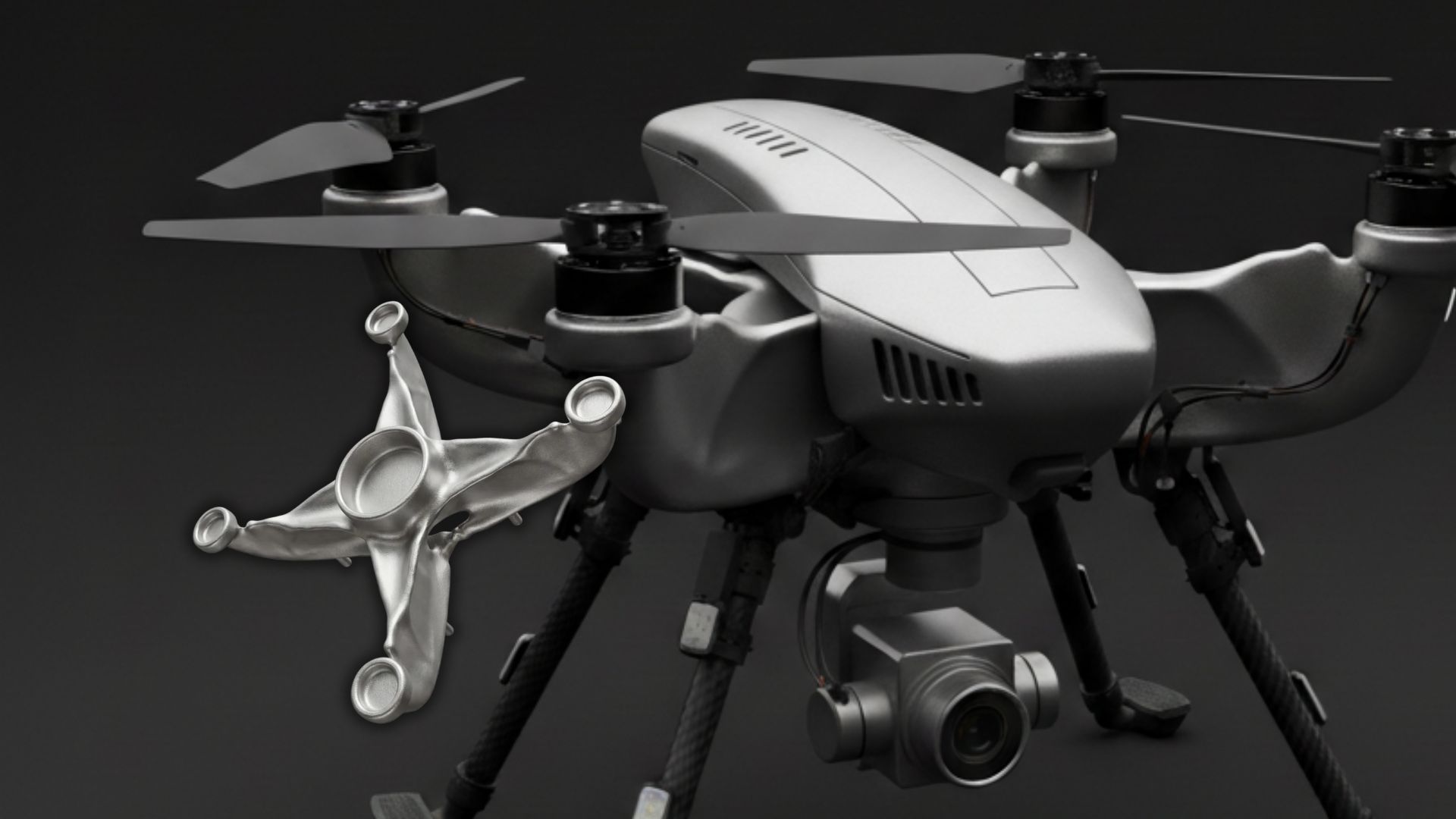
In industrial inspection, drone endurance is directly governed by structural mass. Standard machined aluminum chassis rely on bulk material to maintain rigidity under payload and rotor loads, adding weight that cuts directly into flight time and agility. An industrial drone manufacturer partnered with Cognitive Design to optimize their legacy frame for a 100-unit production run, targeting aggressive mass reduction while validating a cost-effective manufacturing route for series production.
Drone chassis design for heavy-lift applications sits at the intersection of competing constraints: rotor thrust vectors, payload forces, and landing shocks demand robust geometry, yet every excess gram degrades flight time and payload capacity. Traditional workflows force engineers through sequential CAD/FEA loops, each cycle consuming days, and evaluating alternative manufacturing routes means running entirely separate design tracks.
With Cognitive Design, the engineering team explored multiple generative topologies and two material candidates (Ti-6Al-4V versus Al-6061) within a single session, running a critical AM-to-Investment Casting migration study with real-time meshless FEA validating each concept as it evolved.
.png)
Results Achieved
80% mass reduction
The optimized Ti-6Al-4V chassis achieved an 80% reduction in mass compared to the legacy machined block design, dropping from 2.50 kg to 0.50 kg. Topology Optimization generated an organic, skeletal structure that directs rotor thrust and payload forces through the most efficient load paths, eliminating all non-structural material while maintaining a safety factor of 1.5 under 3G landing shock.
87% faster engineering
Using Cognitive Design's integrated workflow, the engineering team compressed design exploration and validation from 172 hours with a conventional software stack to just 23 hours, exploring multiple manufacturing strategies and two material candidates within a single generative study.
85% unit cost reduction through process migration
The manufacturing-driven design workflow enabled a direct migration from metal AM to Investment Casting without redesigning from scratch. By running automated draft-angle analysis and geometry smoothing within Cognitive Design, the team adapted the organic topology for a castable workflow, reducing unit cost from 3,450 EUR to 515 EUR for a 100-part production run, making the lightweight drone commercially viable at scale.

Interested in reading the full case study?
Fill in the form below to instantly receive the full case study.
Aeronautics Challenges We Address



Automotive Challenges We Address



Defense Challenges We Address


Built for the Cognitive Era of Engineering
Shorten product development cycle from the earliest concept phase.
Product engineering cycle
Product engineering cycle
Reusability of engineering workflows
FAQs
Explore our frequently asked questions to understand how our software can benefit you.
Unlock Your Design Potential
Request a demo to see how Cognitive Design by CDS can revolutionize your engineering workflow