Landing Gear Bracket: 60% Weight Reduction Through Assembly-Aware Topology Optimization
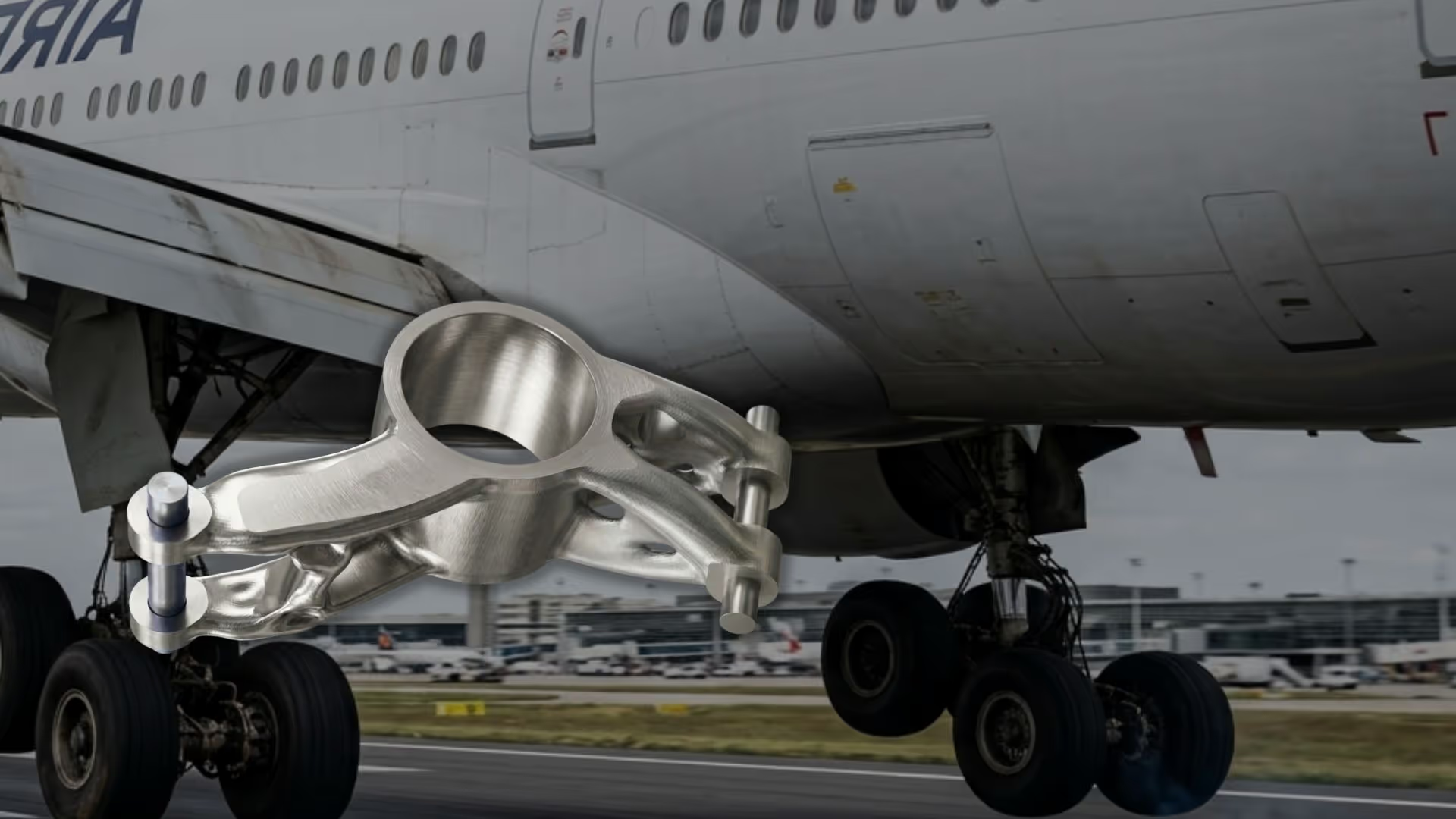
The Part
The landing gear actuation bracket connects the actuation mechanism to the structural airframe, transmitting cyclic loads across three distinct phases: retraction, extension, and ground contact at touchdown. Each phase applies a different force vector through the two fastener interfaces, making the bracket a critical load path component that must remain structurally sound under variable-amplitude fatigue. The legacy design in structural aluminum alloy was dimensioned conservatively, with a peak Von Mises stress of 270 MPa at a mass of 1.4 kg.
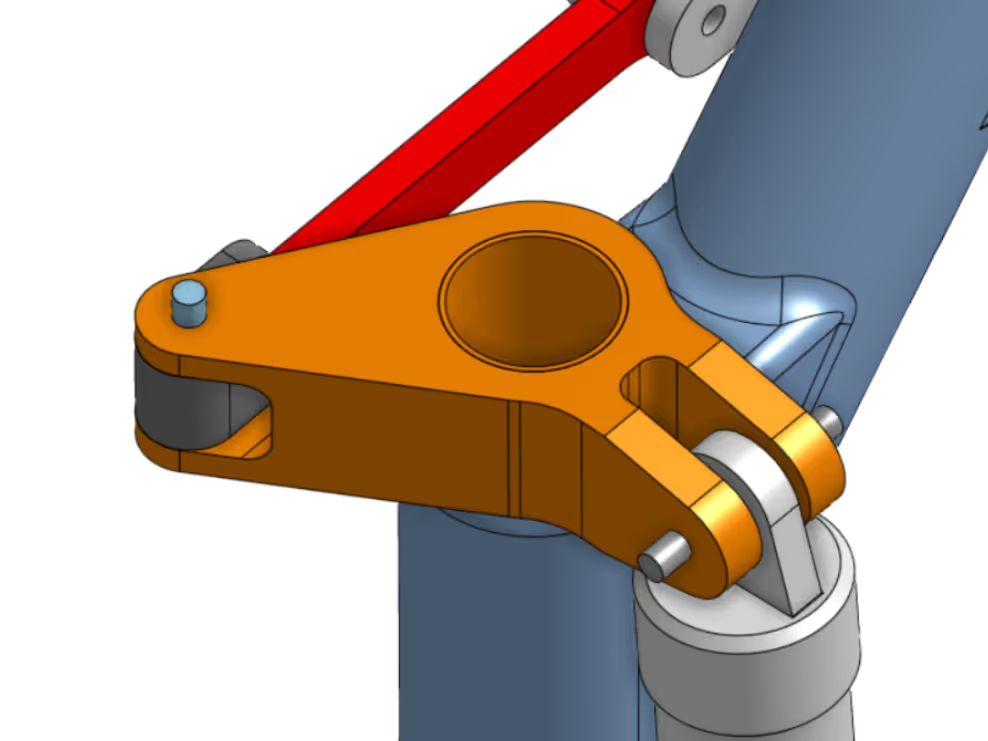
The Challenge
The core engineering pressure was not structural: the legacy bracket met its load cases. The pressure was competitive and programmatic. Landing gear programs face aggressive mass reduction targets driven by fuel efficiency regulations and system-level weight budgets, and conventional concept exploration workflows produce only one or two candidates before deadlines force a decision. Promising design directions go unevaluated simply because there is no time to model them.
The compounding difficulty is the multi-objective nature of lightweighting. Aggressive mass reduction raises peak stress and produces geometry that is harder or more expensive to manufacture. Finding the best trade-off across weight, structural performance, and manufacturability requires evaluating enough concepts to understand the design space, not just producing a lighter part.
The Approach
The team ran two optimization routes in parallel rather than sequentially, generating genuinely distinct geometric families from the same load environment and boundary conditions. This was not iteration on a single concept: it was simultaneous exploration of different material distribution strategies, each producing a different shape family that the team could compare directly on mass, stress, and manufacturable geometry. The concept that the manufacturability and cost analysis pointed to was not the one the initial weight-focused pass would have selected.
Rather than accepting the lightest result, the team used simulation-driven targeted reinforcement to add material back only where structural analysis showed it was needed. The full workflow, including the constraint configuration, the reinforcement placement logic, and the manufacturing and cost assessment method, is documented in the case study.
.avif)
Key Results
- 60% mass reduction from 1.4 kg to 0.56 kg, preserved after targeted structural reinforcement
- Peak stress controlled to +9% above baseline (294 MPa vs. 270 MPa), brought down from a post-optimization peak of 426 MPa
- ~85% faster engineering lead time, from an estimated 8-10 weeks to 1-2 weeks for the first concept
The case study includes the complete before/after metrics table, full Von Mises stress distribution outputs for both optimization routes, and the manufacturability and cost/CO2 comparison data.
Why It Matters
When concept exploration is fast enough to compare competing design families rather than commit to the first viable result, trade-off decisions shift from reactive to intentional. For landing gear and other flight-critical bracket families, this changes both the quality of the selected concept and the engineering time required to reach a decision-ready design.
Download the case study to see the parallel optimization workflow, the targeted reinforcement approach, and the full manufacturability and cost assessment.

Interested in reading the full case study?
Fill in the form below to instantly receive the full case study.
Aeronautics Challenges We Address



FAQs
Explore our frequently asked questions to understand how our software can benefit you.
Running two distinct optimization routes simultaneously, rather than sequentially, generates genuinely different geometric families from the same load environment and boundary conditions. For a landing gear actuation bracket subject to three cyclic load phases, a standard topology optimization route and a Start Design for LevelSet pass produce structurally different material distributions: one favoring interconnected strut members, the other a more distributed aperture pattern. Comparing these families directly at concept stage gives engineering teams real shape diversity to evaluate against mass, stress, and manufacturability criteria, rather than a single result to accept or reject. This parallel approach is what allows a concept selection to reflect the full trade-off space, not just the first viable geometry the workflow produced.
Landing gear actuation brackets operate under three distinct load phases, each applying a different force vector through the fastener interfaces: retraction, extension, and ground contact at touchdown. In Cognitive Design, each phase is defined as a separate load case, applied through the fastener bodies in their correct spatial positions from the legacy CAD environment, so the optimizer sees realistic lever-arm effects rather than loads distributed uniformly across a mounting face. This multi-case configuration ensures the optimized geometry is evaluated against the full actuation sequence, not just the highest-magnitude single event. It also identifies which load phase drives stress concentration in the final design, allowing simulation-driven reinforcement to be targeted precisely at the most demanding condition.
Aggressive topology optimization often produces concepts where mass reduction and peak stress move in opposite directions: the lightest geometry is rarely the one with the best stress distribution. For a landing gear actuation bracket, an initial optimization pass achieved a 60% mass reduction but raised peak Von Mises stress from 270 MPa to 426 MPa. Rather than discarding the concept or accepting the stress level, Simulation-Driven Design was used to add material back exclusively where stress analysis showed it was needed, specifically variable ribbing targeted at the landing load case, where concentration was highest. This localized addition brought peak stress down to 294 MPa while preserving the 60% mass reduction. Adding material precisely where it earns its weight, rather than uniformly thickening the part, is what makes the final trade-off favorable across both structural performance and mass budget.
Automotive Challenges We Address



Defense Challenges We Address


Built for the Cognitive Era of Engineering
Shorten product development cycle from the earliest concept phase.
Product engineering cycle
Product engineering cycle
Reusability of engineering workflows
Unlock Your Design Potential
Request a demo to see how Cognitive Design by CDS can revolutionize your engineering workflow