High-Performance Supercar Brake Caliper Lightweighting
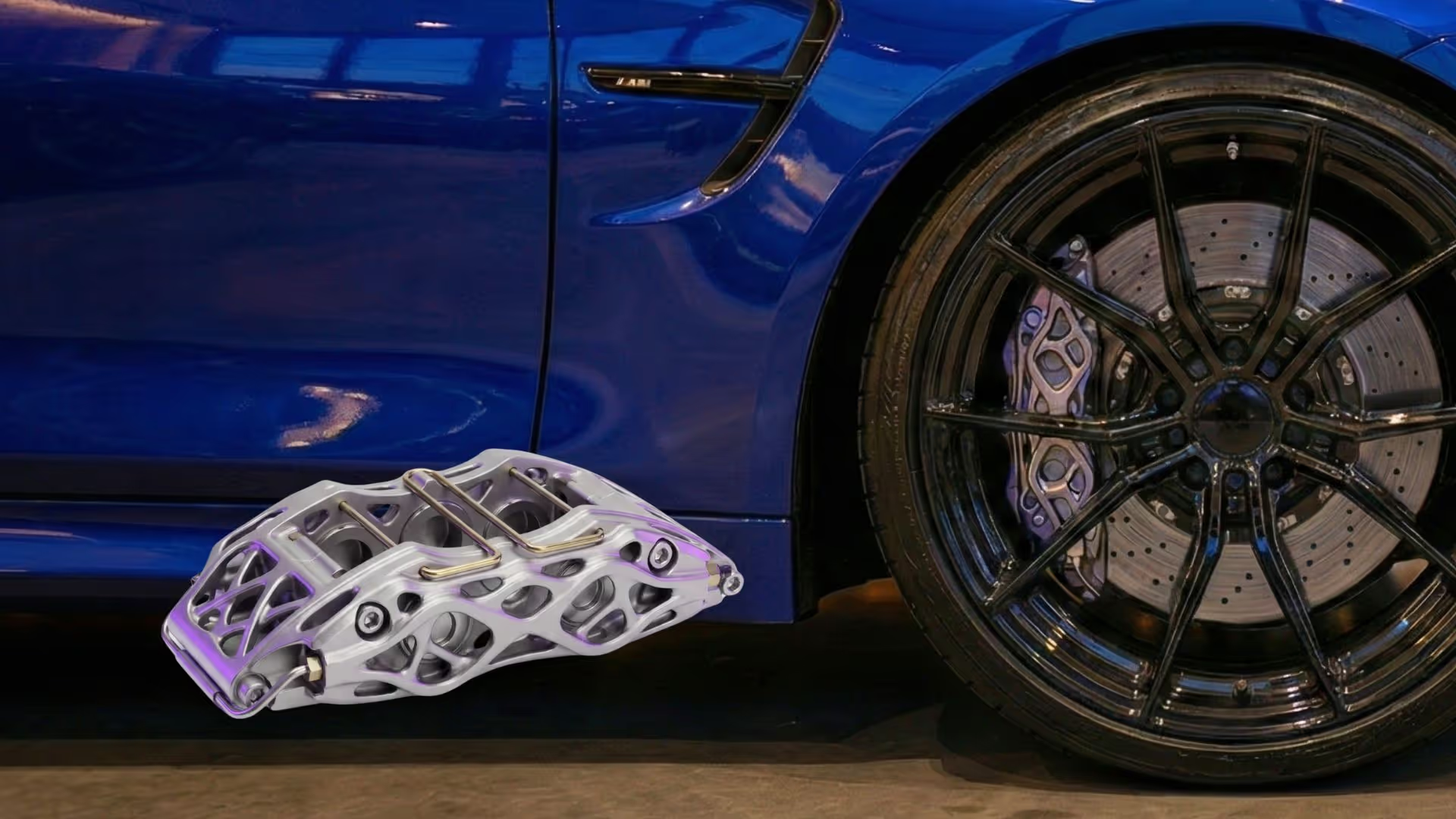
The Part
A brake caliper for a limited-production hypercar (300 units), housing dual pistons, hydraulic channels, and mounting interfaces to the upright. The component operates under repeated hard braking loads reaching 200°C at the pad interface, with hydraulic fluid vaporization a genuine risk without adequate thermal management. Ti-6Al-4V was selected not primarily for its strength-to-weight ratio, but for its low thermal conductivity (~7 W/m·K), which passively protects the hydraulic circuit from heat migration and pedal fade.
The Challenge
The legacy design was aluminum, machined from billet. For a 300-unit production run, high-pressure die casting tooling was cost-prohibitive, which left CNC machining as the default route despite the geometric limitations it imposed. The result was a caliper that was heavier than necessary and constrained to a prismatic form that limited surface area for convective heat rejection.
The engineering team needed to evaluate titanium DMLS against aluminum machining and die casting simultaneously, with structural and thermal FEA both running in real time, without managing three separate design tracks.
The Approach
The team explored three topology-driven design styles across two material candidates within a single generative workflow, with structural and thermal meshless FEA running concurrently on every iteration. The selected design delivered a thermal benefit that the engineering team had not initially modeled as a primary objective: a measurable gain in hydraulic fluid safety margin over the DOT 5.1 wet boiling point.
The case study documents the full three-style exploration, the thermal load case configuration, and the structural and thermal validation results that guided the material and manufacturing route selection.
Key Results
- 42% mass reduction on the selected DMLS titanium variant versus the aluminum baseline
- 16% improvement in caliper stiffness, measurable as improved brake pedal feel
- 13°C gain in hydraulic fluid safety margin over the DOT 5.1 wet boiling point
The case study includes the full three-style exploration results, the concurrent structural and thermal FEA data, and the per-route cost analysis for a 300-unit production run.
.avif)
Why It Matters
Integrating thermal analysis into a structural generative workflow from the first iteration changes what gets optimized. Geometry that manages heat actively, rather than relying on post-process cooling strategies, requires a design environment where both physics can inform the topology simultaneously.
Download the case study to see the three-style topology exploration, the thermal FEA validation, and the full cost and performance comparison across manufacturing routes.

Interested in reading the full case study?
Fill in the form below to instantly receive the full case study.
Aeronautics Challenges We Address



FAQs
Explore our frequently asked questions to understand how our software can benefit you.
In a documented supercar brake caliper optimization, the Ti-6Al-4V caliper achieved a 42% mass reduction, dropping from 3.85 kg to 2.23 kg. Cognitive Design's Topology Weaving approach created a bio-mimetic truss structure directing piston housing loads through organic, high-efficiency paths, delivering superior stiffness at significantly reduced weight.
Topology Weaving generates open-lattice truss geometries connecting load-bearing interfaces through optimized organic paths. In a documented supercar caliper case, the resulting geometry reduced deflection from 0.12 mm to 0.10 mm under 200-bar hydraulic pressure and 2.5G deceleration, a 16% stiffness improvement, despite removing nearly half the original material.
Yes. A single generative session in Cognitive Design explored three manufacturing routes (3-axis CNC, die casting, DMLS) and two material candidates (Al-6061 and Ti-6Al-4V) concurrently, with real-time meshless FEA validating each concept as it was generated. This eliminates the need for separate design tracks per manufacturing route or material.
The porous, high-surface-area geometry produced by Topology Weaving dramatically increases convective cooling capacity. In the documented supercar caliper case, the Topology Weave geometry improved heat dissipation by 18% compared to the solid aluminum predecessor, reducing thermal buildup during sustained high-performance braking.
Cognitive Design compressed caliper design exploration and structural validation from an estimated 140 hours with conventional tools to just 24 hours, an 85% reduction in engineering lead time. This makes it viable to run exhaustive multi-process, multi-material studies even within the tight timelines typical of low-volume exotic vehicle programs.
Automotive Challenges We Address



Defense Challenges We Address


Built for the Cognitive Era of Engineering
Shorten product development cycle from the earliest concept phase.
Product engineering cycle
Product engineering cycle
Reusability of engineering workflows
Unlock Your Design Potential
Request a demo to see how Cognitive Design by CDS can revolutionize your engineering workflow