
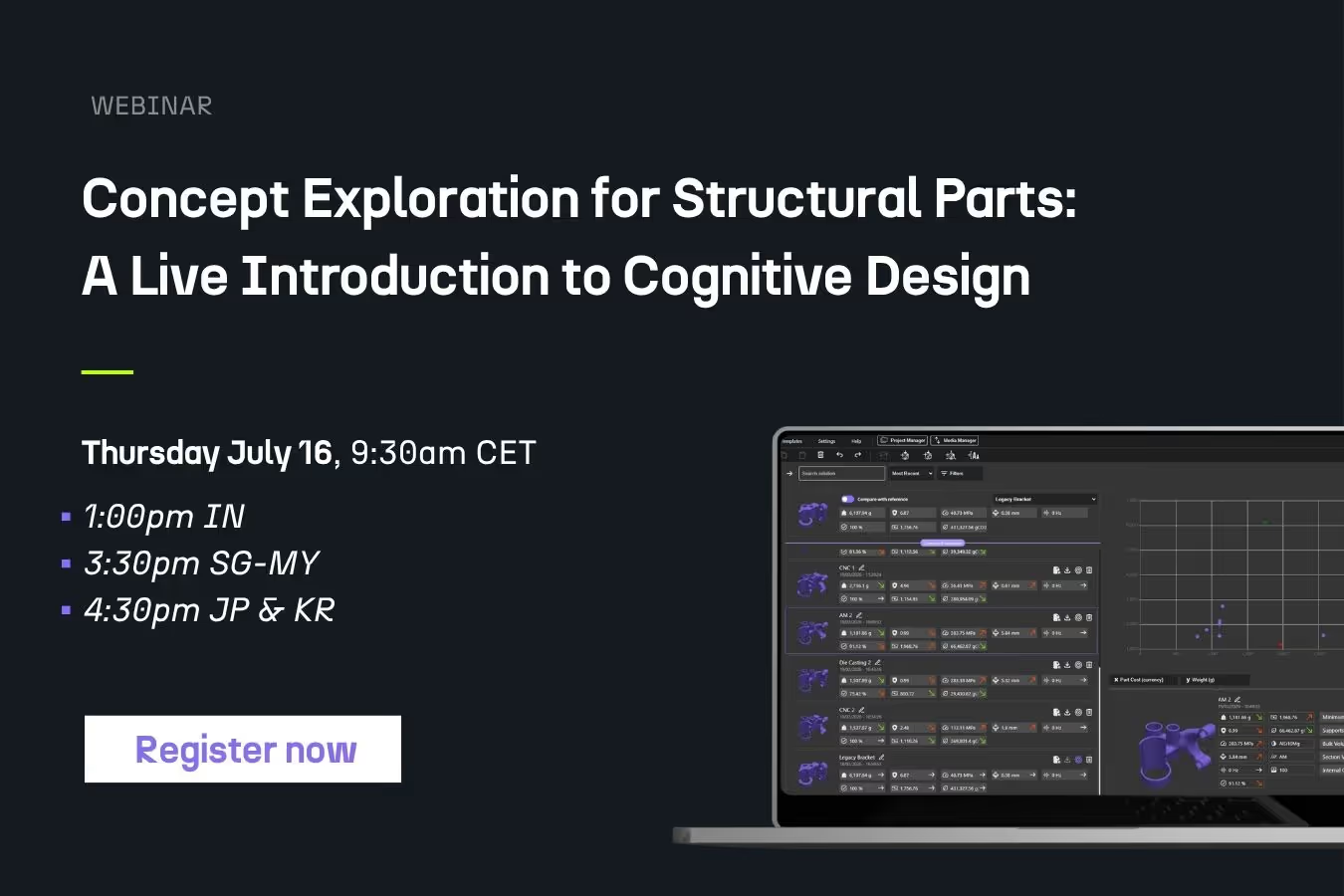
Concept Exploration for Structural Parts: A Live Introduction to Cognitive Design

Engineering teams designing hundreds of structural brackets per year face the same bottleneck: too much time rebuilding models, too little time exploring better designs. Discover how Cognitive Design enables teams to explore wider design spaces at the concept stage and scale a validated methodology across an entire bracket family, without starting over for every variant.

Henri De Charnace
Henri De Charnace
CTO
CDS
Vincent Ung
Vincent Ung
COO
CDS
July 16, 2026
@
9:30 am
45
Days
12
Hours
44
Mins
29
Secs
Sign up today!

Description

In this webinar, we walk through our advanced concept exploration platform, Cognitive Design, on a case derived from a real customer project. This session will be delivered in English, with live translation subtitles available for all participants.

Exploring design candidates at the concept stage remains one of the most resource-intensive steps in mechanical engineering. For teams designing structural and thermo-mechanical parts, the bottleneck is rarely the final design. It is the early phase, where geometry, manufacturing constraints, performance, and cost must all be weighed simultaneously before any meaningful decision can be made. When a parameter changes, most teams begin from scratch.

Cognitive Design capabilities

  • Topology optimization and generative design
  • Structural performance and thermo-mechanical analysis
  • Manufacturing-driven design
  • Multi-criteria candidate comparison (lightweighting, manufacturing process, cost, and carbon footprint) with the Design Explorer
  • Introduction to Cognitive Design's core technology: implicit modeling and reusable parametric workflows

Key takeaways

  • Understanding implicit modeling and parametric design, and how they enable faster geometry generation, reducing concept exploration time by up to 80%
  • Comparing candidates across structural performance, thermal behavior, manufacturing constraints, and cost
  • Selecting the best design candidates before any CAD detailing begins, with up to 40% weight reduction on manufacturable variants

Who should attend

  • Mechanical and design engineers working on structural or thermo-mechanical parts
  • Engineers looking to reduce concept iteration time and achieve meaningful weight reduction
  • Engineering teams in aerospace, space, defense, and automotive sectors evaluating generative design workflows
Henri De Charnace
Henri De Charnace
CTO
CDS
Vincent Ung
Vincent Ung
COO
CDS
Nicolas Bellomo

Thanks to Cognitive Design, we were able to rapidly design and validate a structurally optimized tank that fits within our CubeSat constraints, integrates all required functions, and meets demanding pressure requirements. It’s a game-changer for enabling component design exploration high-performance propulsion in small satellite platforms.

Nicolas Bellomo
CTO

Unlock Your Design Potential

Request a demo to see how Cognitive Design by CDS can revolutionize your engineering workflow