About this webinar
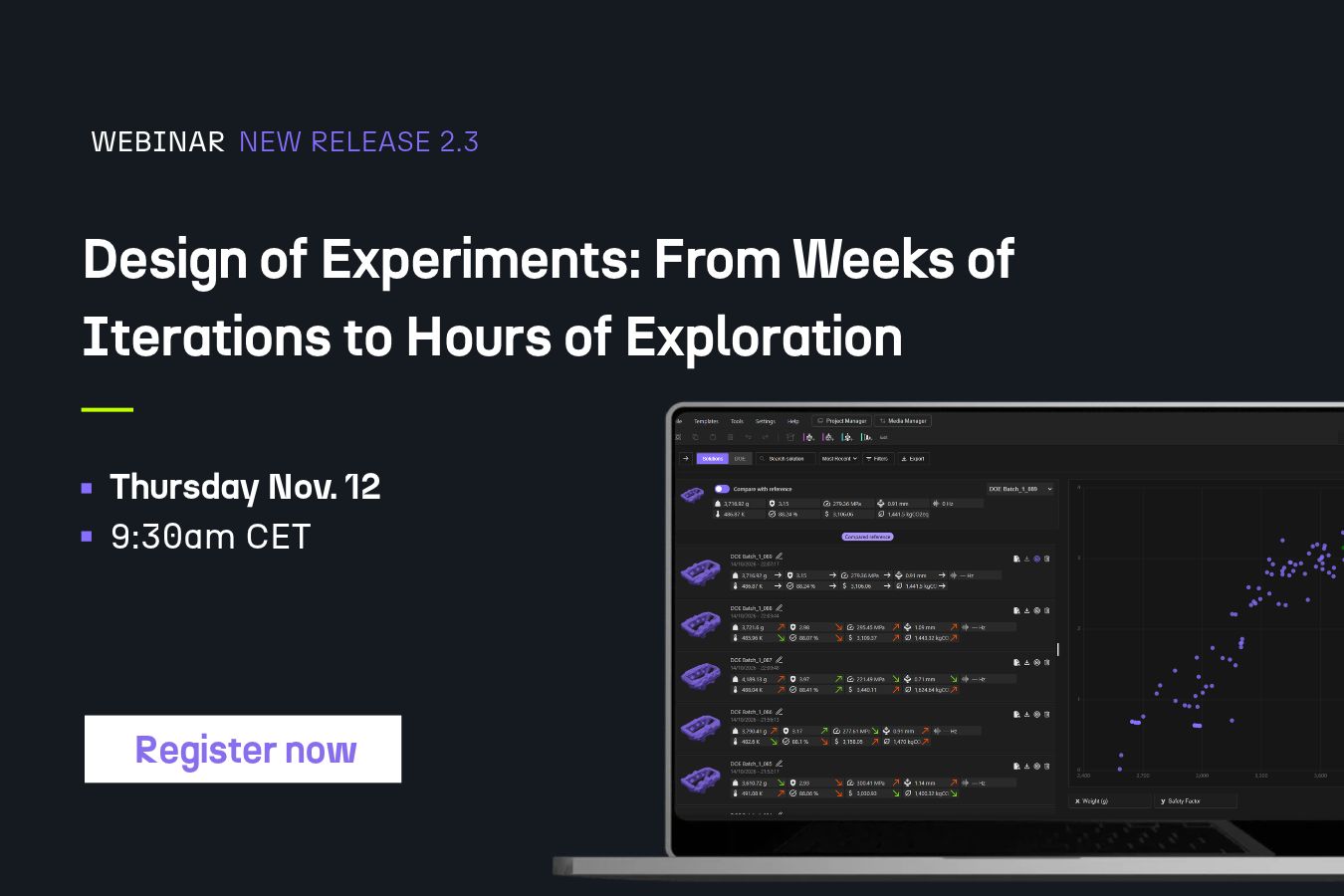
The new Cognitive Design release introduces Design of Experiments (DoE) for the concept phase. Until now, exploration was bounded by engineering hours: change a parameter, rerun, compare, repeat, and stop when the schedule runs out. Now you define what varies and within which ranges, and the platform generates and evaluates the variants systematically, turning weeks of manual iterations into hours. Each variant is produced by the topology optimization, design for manufacturing, and simulation capabilities you already use.
What you'll see
- A wider design space, explored in hours at the concept phase. In the new DoE panel, select the workflow parameters to vary, set their ranges and the number of iterations, and the platform generates and evaluates every variant strictly within those bounds. Weeks of manual iterations become hours, with each variant scored on mass, stress, manufacturability, cost, and CO2, across additive manufacturing, casting, and machining.
- Every variant compared, traced, and ready for design review. All results land in Design Explorer with their full parameter history, so you can compare variants side by side and converge on the best balance of performance, cost, and manufacturing process. The exploration logic stays in a reusable workflow, ready to replay on the next program.
- Stress and natural frequency requirements built into topology optimization. Keep stiffness as the objective while imposing your allowable stress, and set natural frequency targets away from operating excitations. The optimized concept already meets them, with less material added back after the run.
Who should attend
- Mechanical and design engineers working on structural, thermal, or weight-critical parts
- Engineering managers evaluating concept exploration and simulation tools
- Teams looking to unify CAD, CAE, and manufacturing validation within a single concept workflow