Explore Every Concept Within Your Parameter Space With Design of Experiments
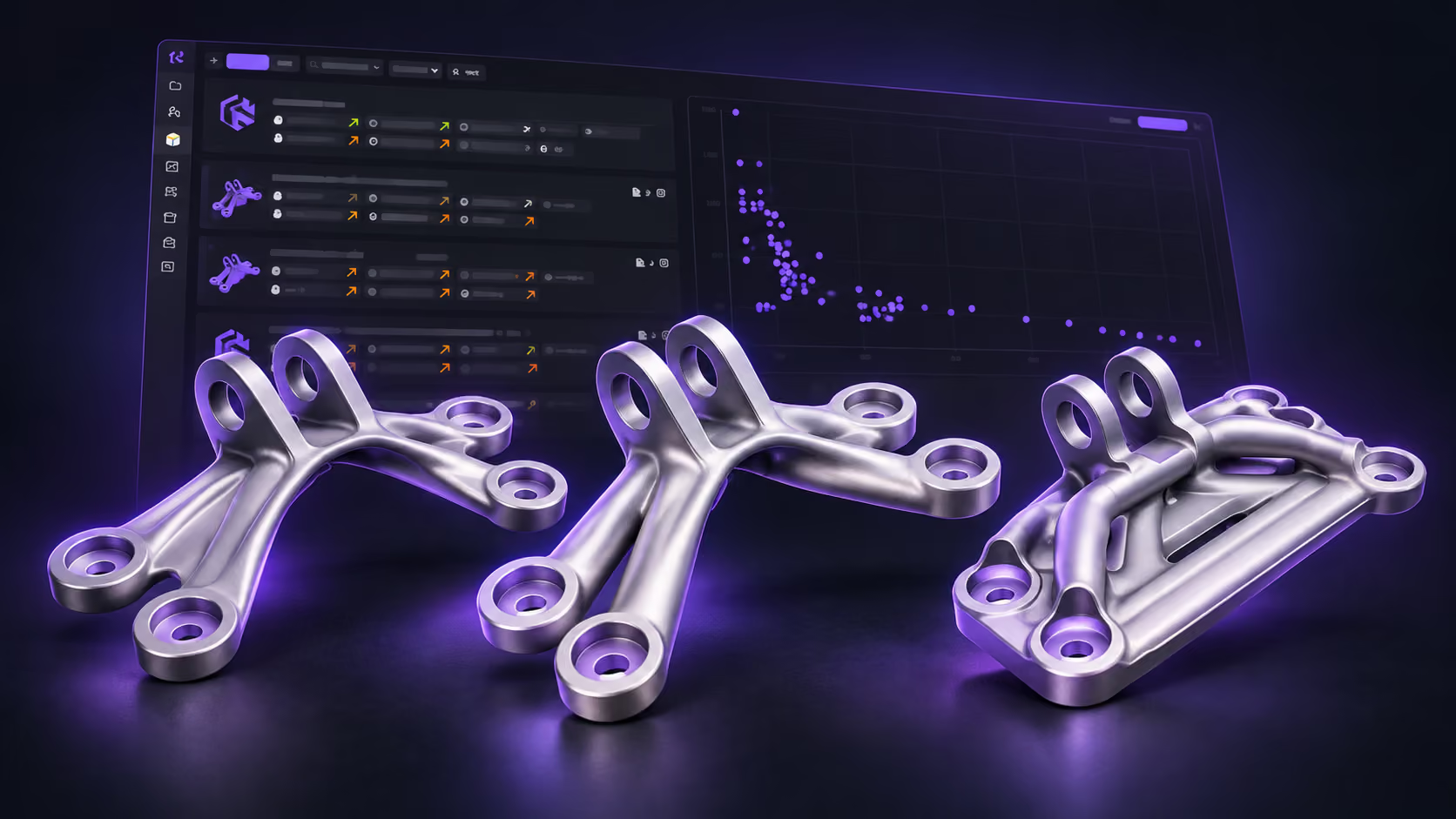
Define the parameters, ranges, and iterations. Cognitive Design generates and evaluates your variants automatically, bringing the results into Design Explorer so you can compare concepts before committing to detailed design.
Trusted by industry leaders worldwide




From Weeks of Manual Iterations to Hours of Systematic Exploration
Design of Experiments automates the runs your engineers used to launch one at a time. Every option inside the parameter space is generated and evaluated on the same criteria, early enough to shape the concept.
To explore a wide parameter space
Performance, manufacturability, cost, and CO2
Reusable, deterministic and traceable logic
The concept phase challenge
Stop Exploring Until Time Runs Out. Explore Until Your Options Are Covered.
In the concept phase, exploration is still largely manual, so the number of options compared is capped by engineering time. Weight, cost, manufacturability, and CO2 gaps then surface downstream, where they are expensive to fix.
Manual exploration TODAY
A Handful of Concepts
Each rerun means manual setup, so only a handful of concepts ever get compared
Generated designs often prove hard or impossible to manufacture, because process constraints are applied too late
Performance is checked one variant at a time, so stiffness, stress, and mass trade-offs stay hidden
The concept is chosen when the schedule runs out, not when the options are covered
With Design of Experiments
Every Concept Evaluated
Every combination in your parameter space is generated and evaluated automatically
Manufacturing constraints run inside the workflow, so every variant is generated for its target process
Structural performance, mass, cost, and CO2 compared side by side across all variants
The concept is selected from a documented comparison, before detailed design
How it works
Turn Generated Variants Into a Concept Decision
The value of exploration is the choice it gives you. Design of Experiments runs the capabilities you already use across your whole parameter space, and Design Explorer brings the results together so you can review every variant against the same engineering criteria.
You define
Parameters to vary
Minimum and maximum values
Number of iterations
Engineering requirements
Compared on
Performance
Manufacturability
Cost
CO2
Design of Experiments Generates.
Design Explorer Helps You Decide.
Every variant from the sweep lands in Design Explorer with its full KPI set attached. It is where your team stops exploring and starts deciding, with no spreadsheets and no screenshots to compare by hand.
Filter Dozens of Variants Down to the Ones That Meet Your Requirements
The KPI dashboard brings all variants into a single view: mass, stress, displacement, safety factor, cost, CO2, and manufacturability. Filters combine across every KPI, and each variant can be compared to your legacy part or specification, with deltas computed automatically.
Video clip · 5-8s loop
2D scatter plot, processes compared
Scatter plot of cost vs. mass with variants colored by process (AM, casting, machining). Toggle one process off then on, then click a variant to open its 3D preview.
MP4 H.264 · 1600x1200 (4:3) · 24-30 fps · no audio · under 2 MB · legend readable
Compare Manufacturing Processes on Data, During the Concept Phase
The manufacturing process drives cost and carbon. Explore each process with its own workflow, plot every variant on a 2D scatter of any two KPIs, such as cost vs. mass or CO2 vs. manufacturability, and compare selected concepts side by side before the choice is locked in.
Export the Exploration as a Report, Ready for Your Design Review
Turn the exploration into a decision document in one click. Export iteration and 1-to-1 comparison reports as PDF, and raw data as CSV. Every variant keeps its parameters, solver inputs, and KPIs, so teams get a documented, replayable rationale for every concept decision.
More Options, Same Criteria, Decisions Based on Data
Design of Experiments gives engineers back the time spent on manual reruns and turns the concept choice into a comparison on data.
Time Back for Engineering Judgment
What used to take weeks of manual reruns now takes hours. Your time goes to decisions instead of iterations.
More Possibilities
Explore more design options than manual iteration ever allowed, including ones you did not have time to reach before, while staying in your current CAD stack.
Multi-Objective, Multi-Process
Each variant is evaluated on performance, manufacturability, cost, and CO2, and processes are compared side by side instead of being picked before exploring.
Control and Trust
You define which parameters vary and within which ranges. Every sweep is deterministic, traceable, and executed on-premise.
For engineering leaders
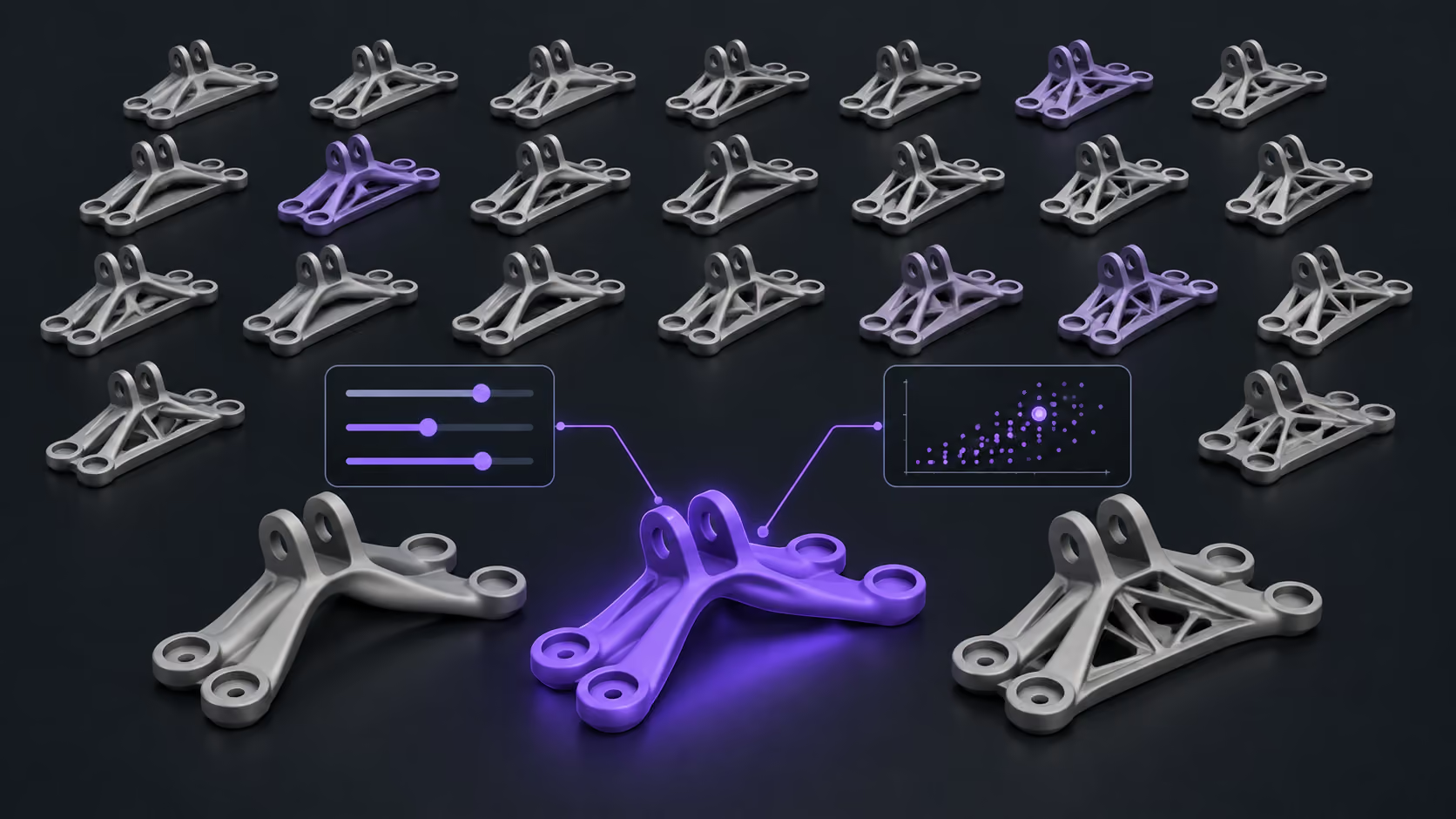
Compare Far More Options in the Concept Phase, All Traceable
All evaluated on the same criteria, all within a parameter space your engineers defined. The comparison arrives early enough to influence the concept, before cost and CO2 are locked in.
Time Management
Exploration that took weeks of manual iteration now takes hours. Engineers spend their time on decisions instead of iterations.
Cost Control
Cost and CO2 are evaluated on every variant. The choice of process, which drives cost and carbon, is made on data instead of being fixed before exploration begins.
Know-How Management
The parameters and ranges your engineers choose are part of a reusable workflow, so exploration logic is captured once and reused on the next program.
Team Alignment
All variants land in Design Explorer, a shared basis for review, so a decision can be explained and replayed.
Control and Trust
The engineer sets the parameters and ranges, and the software explores only within them. Every sweep is deterministic and executed on-premise, with a full audit trail.
Proof
Design of Experiments on Real Parts

Aerospace
Automating the Design of an Entire Bracket Family: How Thales Alenia Space and CDS Accelerated 2x the Full Workflow
Thales Alenia Space automated 80+ antenna tripod variants with one parametric workflow, cutting engineering lead time by 50% and part mass by 45%.
Read the case study →
Automotive
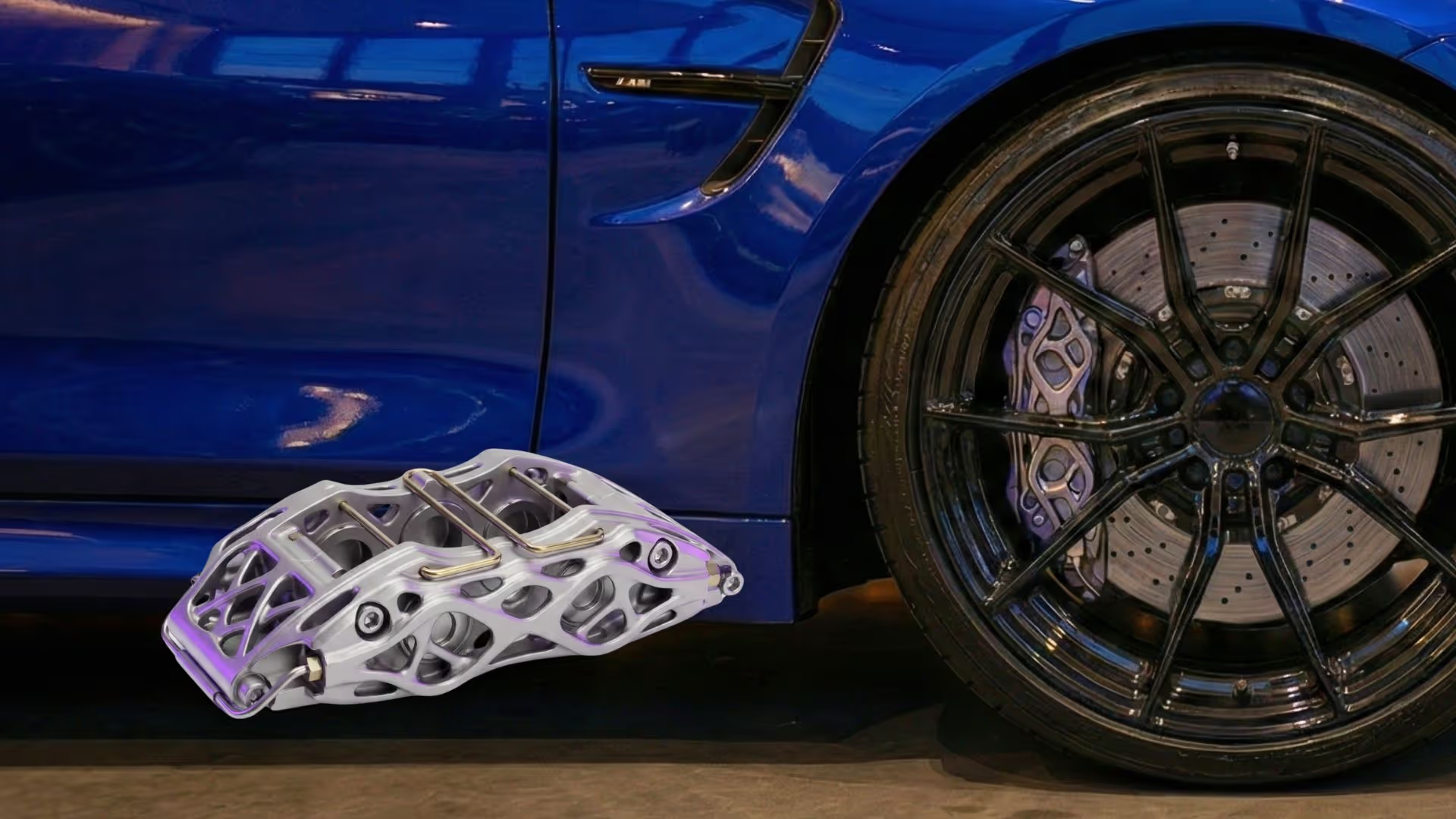
High-Performance Supercar Brake Caliper Lightweighting
42% mass reduction and a 13°C thermal safety margin gain on a high-performance supercar caliper, via topology optimization and DMLS in 24 hours.
Read the case study →

Thanks to Cognitive Design, we were able to rapidly design and validate a structurally optimized tank that fits within our CubeSat constraints, integrates all required functions, and meets demanding pressure requirements. It’s a game-changer for enabling component design exploration high-performance propulsion in small satellite platforms.
Unlock Your Design Potential
Request a demo to see how Cognitive Design by CDS can revolutionize your engineering workflow
FAQs
Explore our frequently asked questions to understand how our software can benefit you.
Design Explorer automates trade-off analysis that traditionally requires days of manual effort. Engineers compare dozens of design variants across multiple KPIs in minutes, making informed decisions faster.
Cognitive Design includes automated Design of Experiments functionality that systematically varies input parameters to understand their impact on outputs. This helps engineers identify critical design drivers and optimise robustly across parameter ranges.
Topology optimisation in Cognitive Design determines the optimal material layout within a design space. The algorithm removes unnecessary material while maintaining structural integrity, resulting in lightweight parts that meet all performance specifications.
Design Explorer enables comprehensive design space exploration by automatically generating and evaluating multiple design variants. Engineers can track KPIs across all configurations, compare trade-offs visually, and identify the best candidates based on performance, weight, and cost criteria.
Cognitive Design uses implicit geometry representation, defining shapes through mathematical functions rather than boundary meshes. This approach enables smooth topology transitions, eliminates mesh-related artefacts, and supports complex lattice structures and organic forms naturally.
Design iterations in Cognitive Design build on previous results intelligently. The platform preserves successful aspects while exploring improvements, converging efficiently toward optimal solutions without redundant exploration.
Cognitive Design uses generative design algorithms driven by performance requirements and manufacturing constraints. The software explores thousands of design variations simultaneously, identifying optimal material distributions that meet structural and manufacturability criteria.
Cognitive Design generates and evaluates design variants in minutes rather than days. Automated simulation and manufacturability checking eliminate manual iteration steps, enabling engineers to explore ten times more concepts in the same timeframe.
.avif)

.avif)

.avif)
