.avif)
Rhushik Matroja
CEO

Generative design promised to revolutionize mechanical engineering. A decade later, adoption remains limited. Not because the concept is flawed, but because current tools fail to address real-world engineering constraints.
This article examines the five systemic bottlenecks preventing generative design adoption and introduces Cognitive Design 2.0, an advanced parametric design exploration platform built to solve each one. Engineering leaders will learn why conventional approaches fall short and how a new generation of on-premises, manufacturing-aware tools is finally delivering on generative design's original promise.
The concept behind generative design is compelling. Instead of the traditional sequential workflow (sketch, refine in CAD, simulate, iterate manually) engineers define objectives upfront: weight targets, load cases, manufacturing constraints. The software explores thousands of design variants. Engineers select and refine the best options.
Ten years ago, this vision captured the industry's imagination. Engineers could finally generate organic, optimized shapes impossible to conceive through traditional CAD modeling. Additive manufacturing provided a production pathway for these complex geometries. The promise was transformative, but the reality has been different.
After extensive conversations with engineering teams across aerospace, defense, and automotive sectors (including organizations like Safran, Thales, and Toyota) a clear pattern emerged. Generative design tools aren't failing because of computational limitations or algorithmic shortcomings. They're failing because they don't fit into real engineering workflows.
Generative design tools excel at creating options. A single optimization run can produce hundreds or thousands of design variants in minutes. But more options don't translate to better decisions—often the opposite.
The core issue is the absence of integrated decision-support infrastructure. Most platforms present results as visual galleries without traceable design logic, built-in KPI comparators, or systematic trade-off analysis. Engineers must manually evaluate each variant against performance metrics, cost implications, weight targets, and manufacturability constraints.
This transforms what should be an empowering exploration process into an overwhelming analytical burden. Teams often default to familiar solutions simply because evaluating the full design space is impractical.
What's actually needed: Automated KPI extraction, graphical comparison tools, advanced filtering by manufacturing process, and traceable logic connecting inputs to outputs. Design exploration should narrow options intelligently, not multiply them indefinitely.
Generative design became synonymous with additive manufacturing—and that association has limited its applicability.
The reality of industrial production is straightforward: most components are die cast, machined, or injection molded. While additive manufacturing has legitimate applications, it remains economically unviable for high-volume serial production in most contexts. Tooling investments, material costs, and production speeds favor conventional processes.
Current generative design tools rarely account for this. They optimize for structural performance and weight reduction, producing organic geometries that look impressive in software but create serious problems in production planning. A topology-optimized bracket may achieve theoretical weight savings of 40%, but if machining it requires five-axis operations, specialized fixtures, and triple the cycle time, the business case collapses.
Most Generative Design platforms lack deep manufacturability analysis for conventional processes. Cost estimation, tooling feasibility, machining accessibility, draft angles for casting, and wall thickness for molding are afterthoughts rather than integrated constraints.
What's actually needed: Manufacturing-driven design that evaluates producibility across die casting, machining, injection molding, and additive manufacturing simultaneously—before engineers invest weeks refining a geometry that can't be economically produced.
Engineers sign off on designs and bear full accountability for performance, safety, and regulatory compliance. This accountability requires understanding, and black-box algorithms fundamentally undermine it.
Many generative design platforms offer minimal visibility into how optimization decisions are made. Constraint handling is opaque, the relationship between input parameters and output geometry is loose and often unpredictable, and small changes to boundary conditions can produce dramatically different results without clear explanation. In unregulated consumer products, this may be acceptable. In aerospace, defense, medical devices, and automotive safety systems, it's disqualifying. Certification requires traceability, validation requires reproducibility, and engineering teams must demonstrate why a design performs as claimed—not simply that software produced it.
The black-box problem extends beyond certification into daily engineering practice. When engineers can't predict how changes will affect outcomes, iteration becomes trial-and-error rather than systematic refinement. Design intent gets lost, and institutional knowledge can't accumulate because the logic isn't transparent enough to learn from.
What's actually needed: Transparent algorithms with clear input-output relationships. Full parameter control. Auditable design logic that supports certification documentation and enables genuine engineering understanding.
Generative design algorithms frequently produce geometries that require substantial post-processing before they're usable in downstream workflows. The typical pattern starts with optimization producing a mesh or organic solid with irregular surfaces, thin features, and geometries incompatible with standard CAD operations. Engineers then export to external tools, manually reconstruct surfaces, repair problem areas, and create production-ready geometry—a process that can take days or weeks for complex components.
The cost isn't just time. This manual intervention breaks digital continuity, severing the parametric link between design intent and final geometry. When upstream requirements change (a revised load case, updated packaging constraints, or new material selection) the entire reconstruction process must restart from scratch. In agile development environments where requirements evolve continuously, this rigidity is crippling. Therefore, engineering teams avoid generative approaches not because the outputs lack value, but because the rework cost of any change is prohibitive.
What's actually needed: Clean CAD output directly from optimization. Fully parametric workflows where requirement changes propagate automatically through the entire design chain without manual reconstruction.
Generative design is computationally intensive, which is why most commercial platforms rely on cloud-based processing to handle calculation loads. However, for many industries, cloud deployment is simply a non-starter.
Aerospace and defense contractors handle export-controlled data, classified programs, and sensitive intellectual property that cannot leave secured networks. Similarly, automotive OEMs protect competitive design information with strict data governance policies. Even companies without formal security requirements increasingly recognize data sovereignty as a strategic concern. While cloud vendors do offer on-premises deployment options, these typically involve significant additional licensing costs, complex IT integration requirements, and reduced functionality compared to cloud-native versions—friction that ultimately discourages adoption rather than enabling it.
What's actually needed: Native on-premises deployment without capability compromises. Complete data sovereignty where all geometry, workflows, and project data remain on local infrastructure under organizational control.
→ External Reference: NIST Cybersecurity Framework for Manufacturing
These bottlenecks aren't inevitable limitations of generative design as a concept: they're implementation failures in current tools, and failures we set out to correct. That's why we built Cognitive Design 2.0: an advanced parametric design exploration platform for mechanical components, designed specifically to address each constraint that has limited generative design adoption in serious engineering environments.
Core Platform Capabilities:
The foundation of Cognitive Design 2.0 is a fully parametric geometry engine with visual workflow construction. Engineers define parameters, constraints, and logic that drive geometry through an intuitive node-based interface, and any change to load cases, dimensions, material properties, or system requirements automatically propagates through the entire model—eliminating manual rework entirely.
Because the platform integrates step-by-step sequential execution with modular operations, engineers can make localized changes without triggering full regeneration while keeping design logic explicit and shareable across teams.

Rather than offering a single optimization approach, Cognitive Design 2.0 includes three distinct generative algorithms, each designed for specific application types.
Our implementation uses level set-based topology optimization rather than the SIMP (Solid Isotropic Material with Penalization) methods common in commercial tools. Level set methods evolve structural boundaries continuously, producing smoother geometry with cleaner feature definition. The approach handles topology changes (creating or removing holes)more naturally than density-based methods.
Critically, Cognitive Design 2.0 couples topology optimization with automated post-processing. Raw optimization output transforms into clean, production-ready geometry without manual CAD reconstruction and this two-step process preserves engineering control while eliminating the reconstruction bottleneck.

Topology Weaving is a proprietary algorithm developed by our team to address topology optimization's transparency limitations. The algorithm connects functional regions through structural pathways (tubes or surfaces)that follow principal stress directions. Engineers directly control section type, pathway radius, connection valency, and routing parameters, so the relationship between inputs and outputs is direct and predictable.
Unlike iterative optimization, Topology Weaving is a direct method. Results generate immediately based on specified parameters. This transparency makes it particularly valuable in certification-sensitive applications where design rationale must be fully documented.

Topology Enclosure generates watertight surface geometries connecting functional regions, that are optimized for housings, enclosures, and packaging applications where organic lattice structures are inappropriate. The algorithm is fully parametric, producing geometries suitable for conventional manufacturing processes. Unlike topology optimization outputs that often require extensive surfacing work, Topology Enclosure delivers production-ready geometry directly.

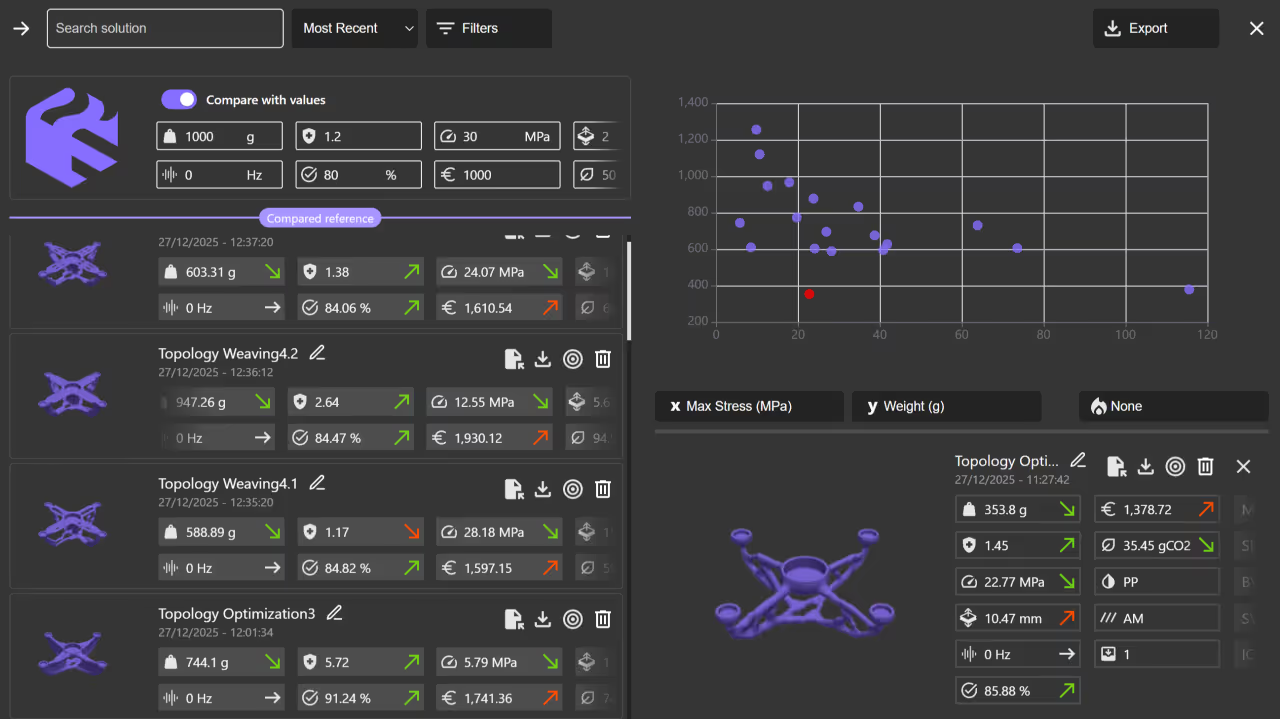
Traditional concept exploration follows a painful pattern: engineers iterate manually in CAD based on experience, await feedback from simulation teams, and incorporate manufacturing constraints reactively. A single concept iteration can consume 30+ hours, and under typical program timelines, teams evaluate fewer than five concepts before committing—far too few to identify optimal trade-offs.
Cognitive Design 2.0 transforms this process through workflow automation and integrated analysis. Engineers construct parametric workflows that capture complete design intent, including geometry generation, generative design application, manufacturing checks, simulation setup, and KPI extraction. While initial workflow construction may take a day for complex components, every subsequent iteration generates in minutes.
The platform analyzes all variants automatically across key performance indicators:
Teams routinely explore 50+ design variants instead of 3-5, identifying optimal trade-offs with full analytical support.

Cognitive Design Systems pioneered automated manufacturing-driven design, using algorithms that detect and repair manufacturability risks directly within the geometry engine. By integrating DFM (Design for Manufacturing) analysis before time-consuming process simulation, engineers catch production issues when they're still easy to fix.
The workflow follows four stages:
This approach supports additive manufacturing, die casting, CNC machining, and injection molding, enabling engineers to iterate rapidly on manufacturable designs rather than discovering production problems late in development.
Cognitive Design 2.0 runs entirely on local infrastructure, meaning no cloud connectivity is required and no data leaves organizational control. All uploaded geometry, generated designs, simulation results, and workflow definitions remain on local servers or workstations. When collaboration is needed, project files in .cds format package complete workflows for secure sharing between team members or sites without relying on external servers.
Computation speed scales with hardware capability. Organizations can size deployments to match workload requirements without external dependencies.
Cognitive Design 2.0 represents more than a tool upgrade. It signals a fundamental shift in how engineering work gets done, and what it means to be an engineer.
For decades, the mechanical engineer's daily reality has looked the same: manually building geometry in CAD, waiting for simulation results, reworking designs based on feedback from manufacturing, and repeating the cycle until deadlines force a decision. Engineers spend more time operating software than actually engineering. The creative, problem-solving work that drew most of us to this profession gets squeezed into the margins.
This model made sense when computational power was limited and design tools were primitive. It no longer does.
For most mechanical engineers, daily work follows a familiar pattern: build geometry in CAD, send it for simulation, wait for results, incorporate feedback from manufacturing, rebuild the model, repeat. It's a sequential process where engineers spend more time operating tools than solving engineering problems. Creativity and technical judgment get compressed into whatever time remains after the software work is done.
Cognitive Design 2.0 fundamentally changes this equation. By automating geometry generation, simulation setup, and manufacturability analysis within unified parametric workflows, the platform handles the repetitive execution work that currently consumes engineering hours. Engineers shift from manual operators to decision-makers: defining design intent, setting meaningful constraints, and interpreting trade-offs across performance, cost, and producibility. The work becomes more strategic, more creative, and more aligned with what engineering expertise actually provides.
The practical benefits follow directly. Engineers can explore dozens of design variants in the time previously required for three or four, making better-informed decisions without extending timelines. Problems that typically surface during tooling or production (casting issues, machining accessibility, cost overruns...) appear in the first weeks of concept development, when fixes are fast and cheap. And because parametric workflows capture design logic explicitly, hard-won engineering knowledge becomes a reusable asset rather than something that disappears when team members move on. Engineers stay accountable for every decision, but those decisions rest on deeper exploration and better data than manual methods could ever provide.
Engineering organizations face compounding pressure from every direction: products must reach market faster, performance requirements intensify, cost targets tighten, sustainability mandates add new constraints, and manufacturing complexity increases even as skilled workforce availability declines. Sequential workflows and manual iteration simply cannot scale to meet these demands, and late manufacturability discoveries are increasingly unacceptable.
Every late-stage design change directly impacts:
The reality is that most engineers already know where the problems will surface. They understand manufacturing constraints and recognize cost drivers, but they lack tools that let them act on that knowledge early enough to matter. By the time visibility arrives, it's too late to influence outcomes without costly rework. Cognitive Design 2.0 bridges this gap by putting performance, manufacturability, cost, and sustainability analysis directly in engineers' hands during concept exploration, when decisions still have leverage and changes still cost hours instead of weeks.
Explore our frequently asked questions to understand how our software can benefit you.
Request a demo to see how Cognitive Design by CDS can revolutionize your engineering workflow