
Henri De Charnacé
CTO

Meshless simulation, also called meshfree simulation, is a class of finite element methods that computes stress and deformation directly on native part geometry, without requiring a conforming mesh to be generated first. The Immersed Method of Moments (IMM), integrated into Cognitive Design, is one such technology. It replaces the meshing step entirely with a structured background grid and custom numerical integration, tailored cell by cell to the geometry it contains.
Meshing remains the single largest source of friction in structural simulation workflows, because generating a conforming finite element mesh demands manual cleanup, domain-specific expertise, and repeated iteration whenever the geometry changes. This friction compounds for parts produced through topology optimization or generative design, where organic, non-manifold surfaces routinely defeat conventional meshing algorithms. As design cycles compress and generative methods introduce more geometric complexity, meshing, not the physics solver, has become the constraint that determines how fast an engineering team can actually iterate.
Well-constructed finite element meshes deliver excellent numerical performance once they exist, and this is not a critique of the underlying element formulations. The problem sits earlier in the pipeline, in the act of building the mesh itself, which often fails outright on increasingly complex geometries coming out of generative design tools.
For simulation analysts, this translates into hours spent fixing mesh artifacts, refining local element density, or manually translating geometry between incompatible file formats before a single load case can run. For design engineers, the same bottleneck disrupts rapid iteration and blocks seamless integration into computational and generative design pipelines, where simulation needs to run automatically on every candidate design.
In short, meshing limits the speed, scalability, and flexibility that modern simulation workflows require, particularly as design exploration becomes increasingly automated.
IMM is a meshfree simulation technology that eliminates the meshing step in finite element analysis by immersing the part geometry in a structured background grid and performing robust numerical integration through custom quadrature rules built specifically for each boundary-intersecting cell. Rather than discretizing the geometry into a conforming mesh, IMM lets the background grid stay fixed and adapts the mathematics of integration to whatever shape falls inside each cell.

This approach enables simulation directly on native geometry, whether that geometry originates as CAD, implicit functions, tessellations such as STL or PLY, voxel data, G-code toolpaths, CT scan reconstructions, or any combination of these representations. Because IMM does not depend on a specific geometric format, it delivers accurate, automated, and representation-agnostic simulation across the full range of formats used in modern design and manufacturing.
"We stopped asking whether a geometry would mesh and started asking whether it made structural sense."
Understanding why IMM eliminates meshing without sacrificing rigor requires looking at the three mechanisms that replace the conforming mesh step, each addressing a different part of the traditional workflow.
The part geometry is embedded in a background grid whose cells, or elements, do not need to conform to the shape of the geometry in any way. Grid cells lying entirely outside the geometry are disregarded, and cells lying entirely inside are treated as standard hexahedral finite elements, exactly as in conventional FEA.
Boundary cells, meaning cells that only partially intersect the geometry, receive special numerical treatment rather than being forced into a conforming shape. This distinction matters because it isolates the computational complexity to a small subset of cells near the surface, while the bulk of the domain uses familiar, well-understood element formulations.
For boundary cells, instead of relying on heuristics such as adaptive sampling or density-scaled integration, IMM performs precise integration using moment-based quadrature. Numerical quadrature rules are constructed by matching the integrals of basis functions, known as moments, over the specific portion of the cell that the geometry actually occupies.
As a result, the quadrature order can be increased for accuracy or reduced for computational speed, in exactly the same way engineers already tune quadrature order in traditional FEA solvers. This preserves a familiar accuracy-versus-speed lever for teams already comfortable with conventional finite element practice.
Because IMM operates through moment integration rather than surface discretization, it supports a wide range of geometry representations, as long as the volume enclosed by that representation can be computed mathematically. This includes traditional formats such as CAD boundary representations and tessellations, as well as non-traditional inputs like implicit functions, G-code toolpaths, and CT scan reconstructions.

This flexibility makes IMM highly adaptable to modern design and manufacturing workflows, where a single part might pass through several representations, from an implicit topology optimization result to a sliced G-code file, before reaching final inspection.
IMM can accurately simulate arbitrary geometry without relying on a conforming mesh because its moment-fitting quadrature rule preserves the integrals that define the underlying system physics, generalizing the logic of Gauss quadrature to shapes that have no standard form.
A quadrature rule approximates an integral by evaluating a function at a small number of strategically chosen points, called quadrature points, each weighted appropriately. An n-point Gauss quadrature rule in one dimension, for example, integrates all polynomials up to degree 2n minus 1 exactly, which means the rule is fitted to match the moments of monomials such as 1, x, and x squared over the integration domain.

These integrals of monomials, denoted Mk and defined as the integral of x to the k over the domain, are called moments, and they encode essential geometric and analytic information about the shape being integrated. A useful way to state this: moments are lumped representations of mass that preserve the specific integrals a simulation actually needs, rather than approximating the geometry itself.
Gauss quadrature is one such rule, optimized specifically for standard, regular shapes, but standard rules break down when the domain is irregular or non-conforming, which is precisely the situation IMM is built to handle. Instead, IMM uses moment fitting, a process where a quadrature rule is constructed on the fly for each boundary cell by solving a system of equations tied to that cell's actual intersected geometry.
These custom quadrature rules are designed to preserve key moments up to a desired order, which ensures accurate integration even when a cell is only partially filled by the geometry. The result is a bespoke quadrature rule for every boundary cell, one that preserves the same mathematical fidelity as Gauss quadrature while adapting to arbitrarily complex shapes.
Beyond eliminating the meshing step itself, the moment-based foundation of IMM produces three further advantages that matter for how simulation integrates into a broader engineering pipeline.


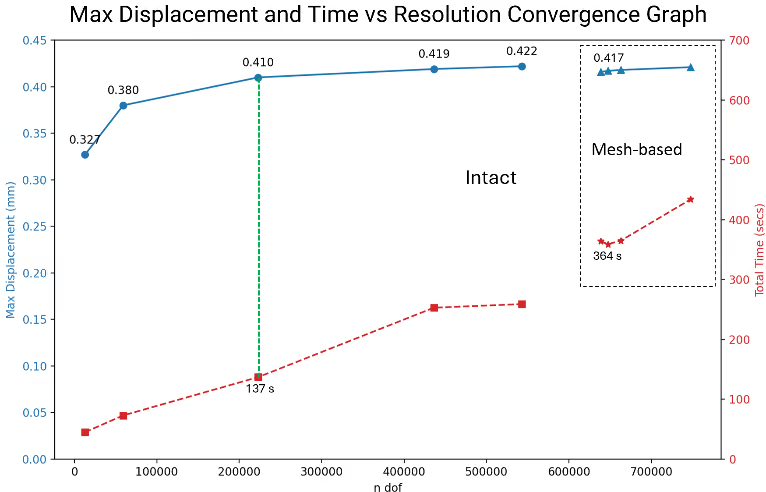
IMM has been benchmarked directly against conventional mesh-based FEA using stress and deformation results on geometrically complex models, and the two methods show close agreement across both metrics. Displacement results differ by less than 1 percent, and stress results differ by less than 5 percent, which places IMM within the range engineers already treat as acceptable variation between two independently meshed conventional models.
.avif)
The Immersed Method of Moments offers a modern foundation for structural simulation that is rigorous, adaptable, and built for automation, rather than an incremental improvement to conventional meshing. By replacing the fragile meshing step with moment-based integration, IMM brings accuracy, flexibility, and scale to simulation pipelines built around today's most geometrically demanding design workflows.
For teams looking to apply this foundation to specific engineering challenges, related resources cover how topology optimization interacts with manufacturing constraints, how simulation-driven design uses live FEA feedback to refine geometry, and how Cognitive Design integrates these methods into a single parametric workflow.
Explore our frequently asked questions to understand how our software can benefit you.
It is a validation approach that works directly on an implicit representation of the geometry rather than a discretized mesh, which avoids remeshing at every iteration and significantly speeds up design loops.
IMM embeds the part geometry in a fixed background grid rather than building a mesh that conforms to the part's shape, and it uses moment-based quadrature to integrate accurately over cells that only partially contain the geometry. This removes the manual meshing step entirely while preserving the same finite element mathematics for interior cells.
Yes. IMM supports any geometry representation for which the enclosed volume can be computed, including CAD boundary representations, tessellations such as STL or PLY, voxel data, implicit functions, G-code toolpaths, and CT scan reconstructions, without requiring a format-specific meshing step.
No. Benchmarking IMM against conventional mesh-based FEA on geometrically complex models shows displacement results within 1% and stress results within 5%, which is within the range of variation typically seen between two independently meshed conventional models.
Yes. IMM is designed for plug-and-play integration with existing solvers, including open-source tools such as MFEM and commercial platforms such as NX Nastran, extending them to meshfree simulation without requiring a full solver rewrite.
Moment-based quadrature is a numerical integration technique that constructs custom quadrature rules by matching the integrals of basis functions, called moments, over the exact portion of a cell occupied by the geometry, generalizing standard Gauss quadrature to irregular, non-conforming shapes.
Generative design and topology optimization frequently produce organic, non-manifold surfaces that break conventional meshing algorithms, forcing manual cleanup that slows down or blocks automated simulation pipelines built around those geometries.

Request a demo to see how Cognitive Design by CDS can revolutionize your engineering workflow
.avif)

.avif)
.avif)
