Rhushik Matroja
CEO

Last updated: November 2026
Engineering organizations archive every CAD model, simulation file and change record, yet the knowledge that made a senior engineer's designs reliable rarely survives their departure. Engineering knowledge capture is the practice of preserving that knowledge as a reusable asset: not only the files an engineer produced, but the decision logic, constraints and validation criteria behind them.
The timing matters because the workforce that holds this knowledge is turning over. McKinsey estimates that about a third of aerospace and defense employees are aged 55 or older, which means that the judgment accumulated across several program generations is now leaving faster than it is being recorded.
This guide explains what engineering knowledge capture covers, why CAD, CAE and PLM systems leave its most valuable layer unrecorded, and how reusable workflows turn that layer into an engineering asset, for design engineers, methods and tools teams in aerospace, automotive and industrial manufacturing, and for the managers responsible for program continuity.
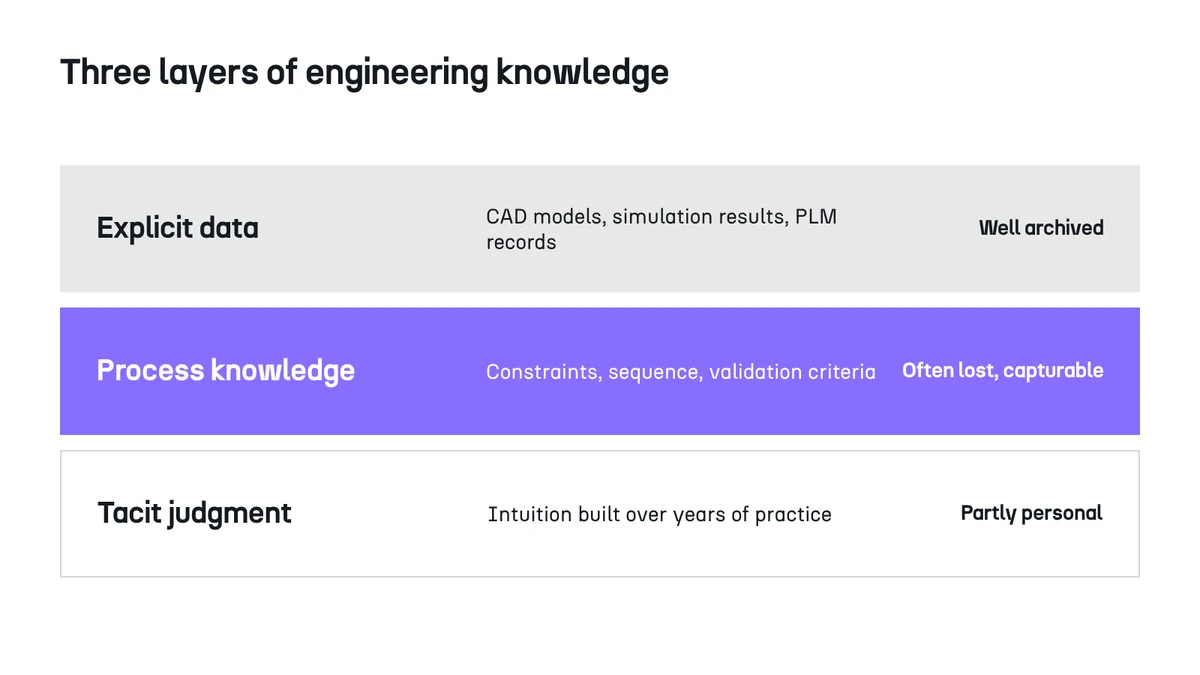
Engineering knowledge capture is the practice of turning the know-how behind a design into an asset the organization can store, reuse, and transfer. It covers three layers: explicit data such as CAD and simulation results, tacit judgment that stays personal, and process knowledge, the sequence of decisions, constraints, and validation criteria that produces a reliable result. That middle layer is the one most often lost and the one that can be encoded.
The first layer is already well served, since PLM and PDM systems archive every version of every assembly with traceable change records. The third layer, pure intuition built over years of experience, will always remain partly personal, and no tool should pretend otherwise.
Between them sits what can be called decision architecture: which boundary conditions to apply, which material properties to trust, which manufacturing constraints are hard limits and which are negotiable, and in what order. This layer is structured enough to be written down, yet it rarely is.
Engineering knowledge leaves with people because the most valuable part of it was never stored anywhere else. A senior engineer's value lies less in running a solver than in knowing how to set it up, sequence it, and judge its output. When that logic lives only in their head, every departure, retirement, or reorganization erases it, and workforce data shows those events are accelerating.
The 2025 Aerospace Industries Association workforce study, conducted with McKinsey across more than 30 organizations, found that industry-wide attrition remains stuck at nearly 15%, while the sector grows at 4.8% per year. The same study reports that 76% of member organizations face sustained challenges hiring engineering talent.
To understand why these figures matter beyond HR metrics, it helps to look at what actually disappears when an engineer leaves.
A senior engineer's real value was never their ability to run a topology optimization solver, which any trained colleague can launch. It was knowing how to frame the problem so that the solver produced a part that could be manufactured, certified, and delivered on the first attempt.
What disappears with them is therefore not a dataset but a sequence of decisions: which load case dominates, which interface tolerance is negotiable, which manufacturing rule the supplier actually enforces. Most of these decisions were never written down because, at the time, the engineer who made them was still available to answer the question.
The geometry can be recreated; the process that produced it to certification-grade standards cannot.
This is precisely what conventional documentation misses, because a handover note records outcomes while the reasoning that produced them stays implicit. The consequence becomes visible only when the next program starts.
At the scale of an organization, these individual losses accumulate into a recognizable pattern.
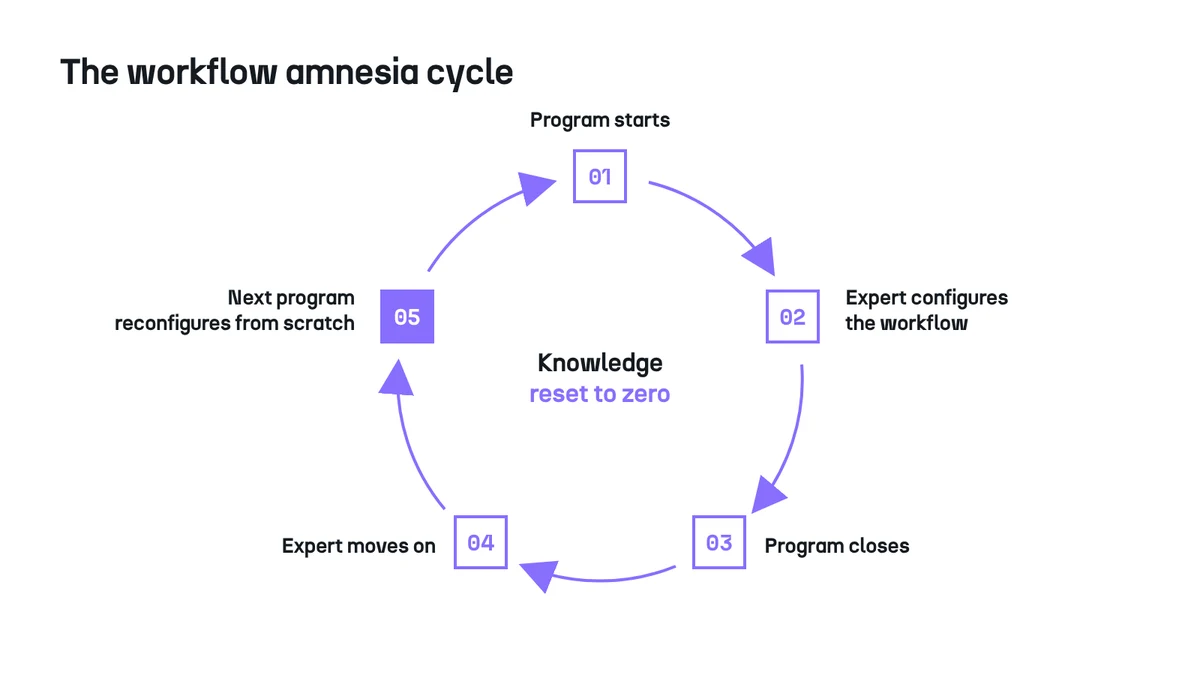
The organizational effect has a name: workflow amnesia, the systematic forgetting that happens every time a project ends, a team restructures, or a key person moves on. Every new project must re-learn what the last one already knew, and every new engineer reconfigures what a predecessor spent months perfecting.
The demographic pressure makes this worse each year. McKinsey observes that younger employees are twice as likely as veterans to change jobs, which means knowledge is now leaving from both ends of the age pyramid at once.
At the scale of the wider manufacturing sector, Deloitte and The Manufacturing Institute estimate that 3.8 million manufacturing jobs will need to be filled in the US between 2024 and 2033, and up to 1.9 million could remain unfilled. Each unfilled seat is also a missing link in the transfer of process knowledge.
Legacy CAD, CAE, and PLM platforms were built around a geometry-first paradigm. They capture what was designed with great precision, but they remain largely blind to how and why it was designed that way. The sequence of operations, the manufacturing rules applied, and the validation criteria used live in engineers' heads, email threads, and handover documents that few people read.
The gap is measurable: in a 2023 survey by CoLab, 87% of engineering leaders estimated that tracking down the justification for a single design decision takes several hours to multiple days. The same research found that 43% of design review feedback is never tracked or addressed.
Two structural limits explain why existing tools leave this gap open, and why the cost of that gap grows with every new variant.
CAD systems record features, dimensions, and assemblies, and CAE tools used for simulation-driven design record meshes, loads, and results, but neither treats the chain of decisions between them as an object worth storing. The workflow logic, from topology optimization to manufacturing-driven design rules to FEA validation, remains an informal practice.
PLM systems were supposed to close this gap, yet in practice they solve a different version of the problem. They version geometry and manage configuration, but they do not package an instruction such as "run topology optimization with these constraints, apply CNC machining rules, then validate to this stress target" as a reusable asset.
Workflow therefore remains an afterthought, buried in a PDF at program close-out when it is documented at all. The comparison below shows where each common support stores knowledge, and where it does not.
The second limit is less visible in any single project, but it grows with every new variant the team has to deliver.
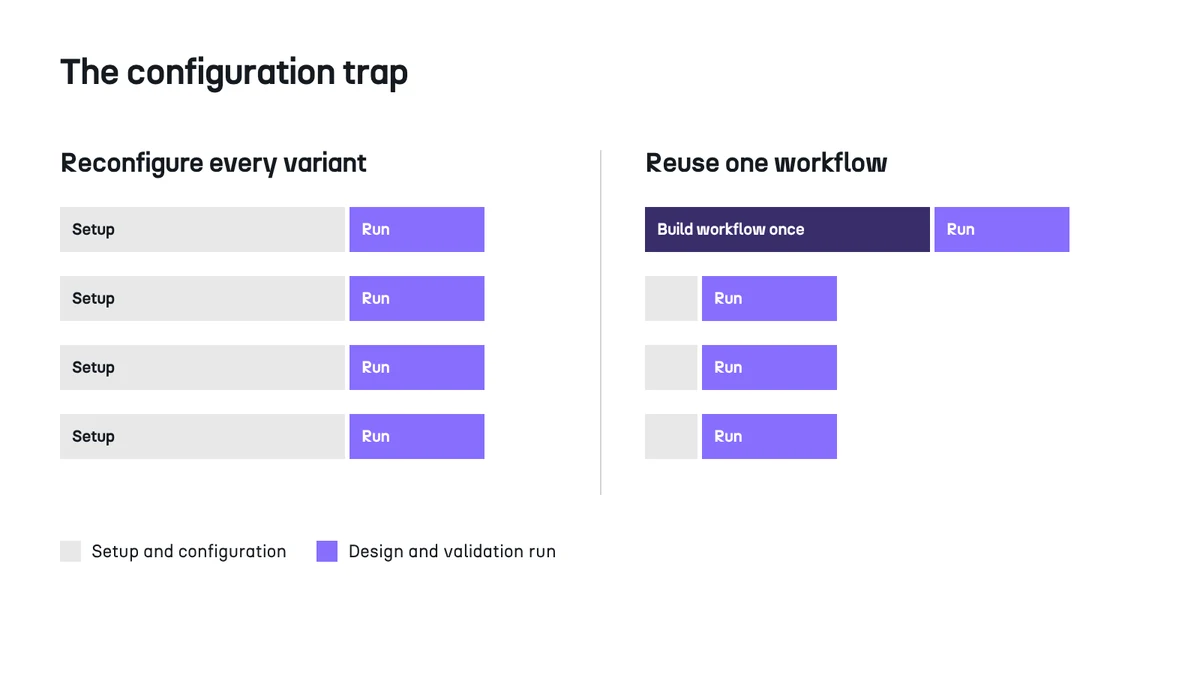
It appears whenever a new variant arrives. Engineers rebuild the CAE setup from scratch for each part even though the underlying logic is identical, a pattern known as the configuration trap, and one that consumes expert time on tasks that add no engineering value.
Every new program, client engagement or engineer therefore starts from zero configuration, with no guarantee that the new setup matches the quality of the last one. CoLab's research reports that 90% of companies delay product launches because of late-stage design changes, many of which trace back to constraints a previous team already knew.
In aerospace and automotive, where certification requires traceable and repeatable processes, this becomes a structural vulnerability rather than a simple inefficiency. Certification authorities and AS9100 quality systems expect evidence of how a part was designed and substantiated, and a team that cannot explain how a previous bracket was validated must rebuild that evidence, which is why aerospace programs keep redesigning the same bracket.
A reusable engineering workflow treats the process itself as a deliverable. It packages the design space, load cases, material rules, manufacturing constraints, optimization targets, and validation thresholds into one executable, versioned asset. Any engineer can rerun it on a new variant, adapt it to a new requirement, and extend it, so the expert's logic survives their departure and remains available to every future program.
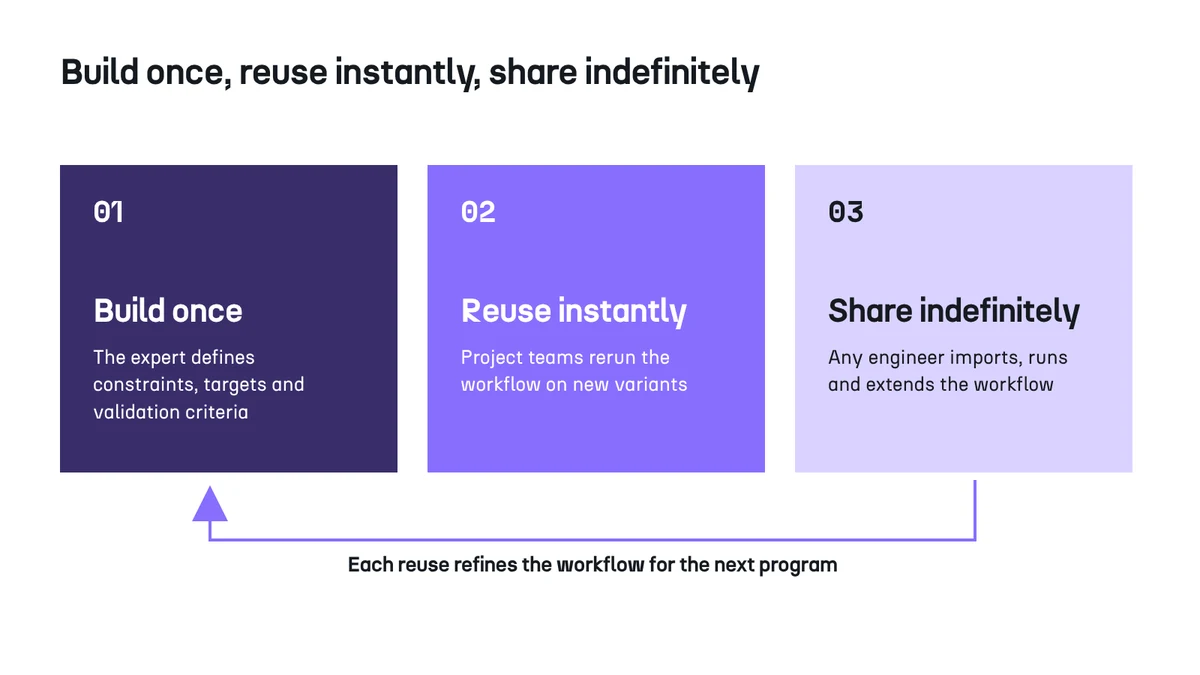
Its value grows with every program that reuses it, and this is not a theoretical proposition, since the technical architecture to make it real exists today. The principle can be summarized in three steps: build once, reuse instantly, share indefinitely.
The first step is where the expert's judgment is invested, and it determines the quality of everything that follows.
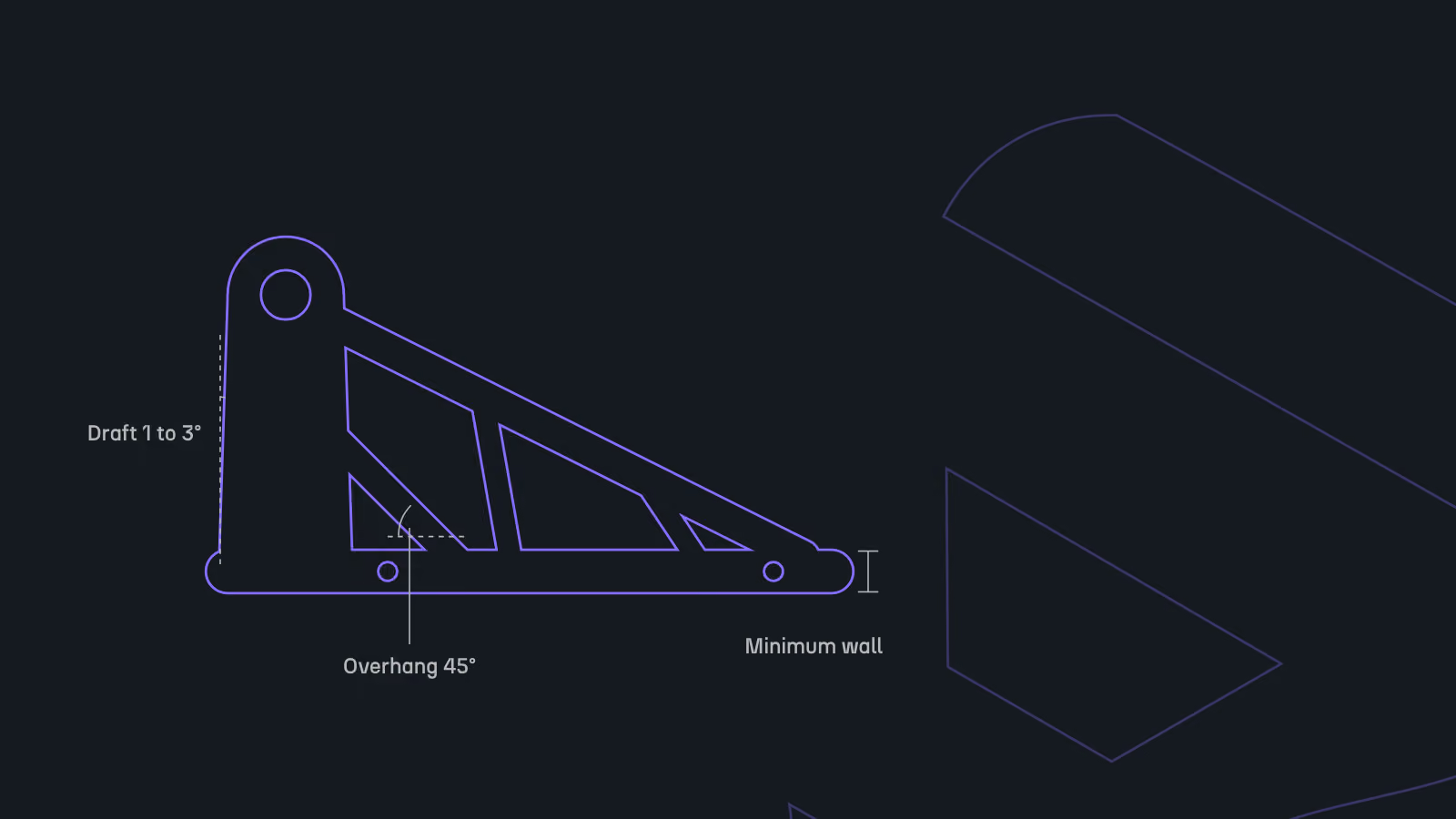
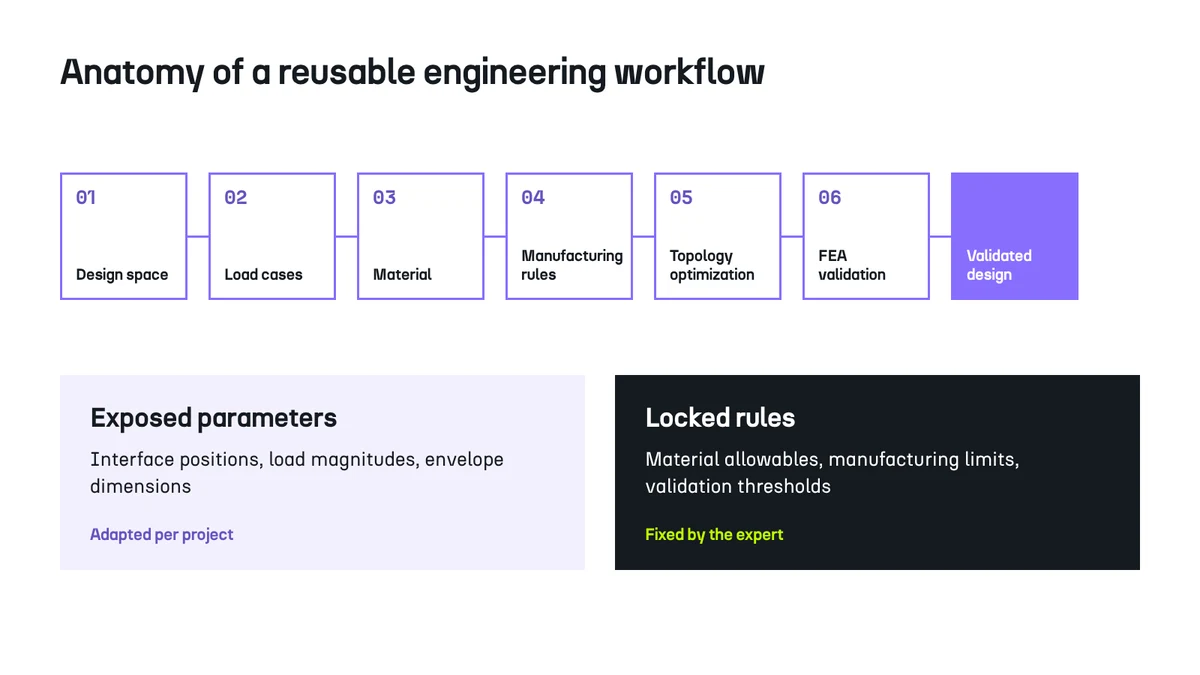
Building a workflow means defining the design problem properly from the start, so that the expert's judgment is recorded in the workflow rather than in a handover note. Four elements are encoded at this stage:
This takes time and requires the judgment of the best engineers, but it happens once per workflow class. For a satellite bracket, this typically means quasi-static launch loads, a stiffness target at least equal to the legacy part, and a mass ceiling such as the 250 g limit applied to the Thales Alenia Space tripods.
A critical design choice at this stage is deciding which parameters remain exposed for future users, such as interface positions or load magnitudes, and which rules stay locked, such as certified material allowables. That separation is what makes a workflow both flexible and safe to hand over.
Once the workflow exists, its value appears the moment a similar requirement arrives.
When a new project arrives with a similar geometry or requirement set, the same workflow applies, load cases adapt, and material specifications carry over. At Thales Alenia Space, a single parametric workflow covering an antenna reflector tripod family brought each new variant to 2 days instead of 2 weeks. The first bracket still carried the cost of building the workflow, comparable to one conventional design cycle, and the gain comes from every variant that follows.
The engineer's time then goes to judgment and interpretation rather than reconfiguration, which is exactly where senior expertise should be spent, as detailed in the Thales Alenia Space bracket family webinar.
Reuse within one team is only part of the gain; the larger effect comes when the workflow leaves the team that built it.
The final step makes the knowledge independent of any one person. The complete workflow, with its constraints, targets, sequence, and validation criteria, can be packaged as a single file and distributed to any engineer on any team, who imports it, runs it, and extends it.
When the deliverable is the part, the knowledge is a byproduct; when the deliverable is the workflow, the knowledge becomes the asset.
The trade-off is real: a workflow is only as good as the expert who built it, and a poorly defined design space will be reused as faithfully as a good one. Peer review of the workflow itself, not only of its outputs, therefore becomes a new engineering responsibility.
Reusable workflows change how engineering capacity scales. Consistency and onboarding become structural rather than personal, concept exploration starts from validated knowledge instead of a blank page, and each reuse makes the workflow more robust. For a sector that the AIA says must find at least 30% more productivity in its existing workforce, this is a structural lever, because it raises output without depending on additional senior hires.
The first change concerns how consistently a team works, and how quickly a new engineer becomes productive.
Topology rules, material choices, and manufacturing constraints are embedded in the workflow itself rather than depending on an individual remembering to apply them. Configuration time drops from weeks to days, and two engineers running the same workflow on the same inputs obtain the same result because the solver chain is deterministic, which is the foundation of traceability.
The usual framing of the skills gap, that the industry simply needs more qualified engineers, is partly correct but misses a more tractable solution. If institutional knowledge is encoded in reusable workflows, every engineer who joins inherits the collective intelligence of their predecessors from the first day.
The effect is a change in what limits a team's capacity: throughput depends less on how many senior engineers are available to configure each part, and more on how many validated workflows the organization already holds.
Consistency matters everywhere, but captured knowledge has the greatest impact at one specific moment in a program.
NASA reports that about 75% of life cycle cost is committed by the end of the design phase while only about 15% has been spent. The design phase is also where expert knowledge matters most, yet senior engineers are rarely available to review every early option.
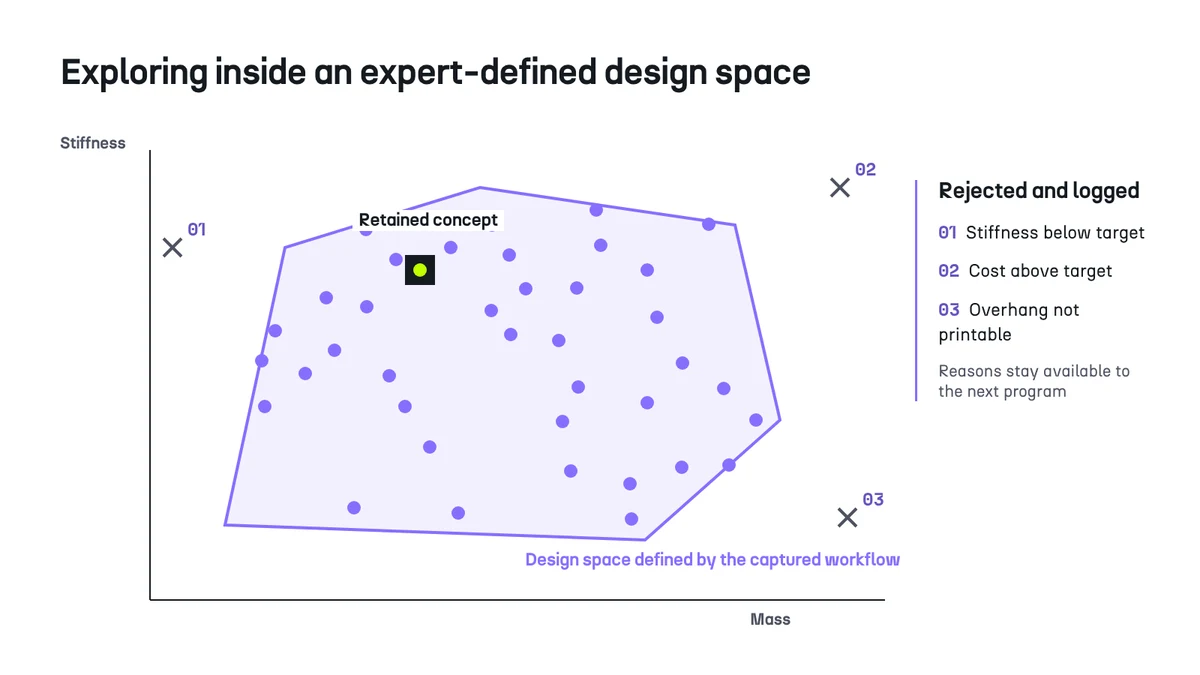
A captured workflow brings their judgment into concept exploration without requiring their presence. Because the workflow carries the manufacturing rules, load cases, and validation thresholds, every concept generated during AI-augmented exploration stays inside a design space the expert defined, and every option complies with the encoded manufacturing rules and can be checked against the same validation thresholds, rather than being a geometric curiosity. Where a conventional workflow develops 2 to 3 concepts manually, a captured workflow can drive 50 to 100+ variants in parallel.
The practical result is a shorter path from concept to final part, because the constraints that usually force late redesign are already present when the concept is chosen.
Exploration also produces a form of knowledge that never reaches PLM: the reasons why concepts were rejected. When a workflow logs which options failed on stiffness, cost, or manufacturability, as in this aircraft bracket manufacturing method study, the next program does not re-explore the same dead ends, which is the knowledge most quickly lost when an exploration lead leaves.
Beyond individual decisions, the economic effect of reuse appears at the scale of a whole part family.
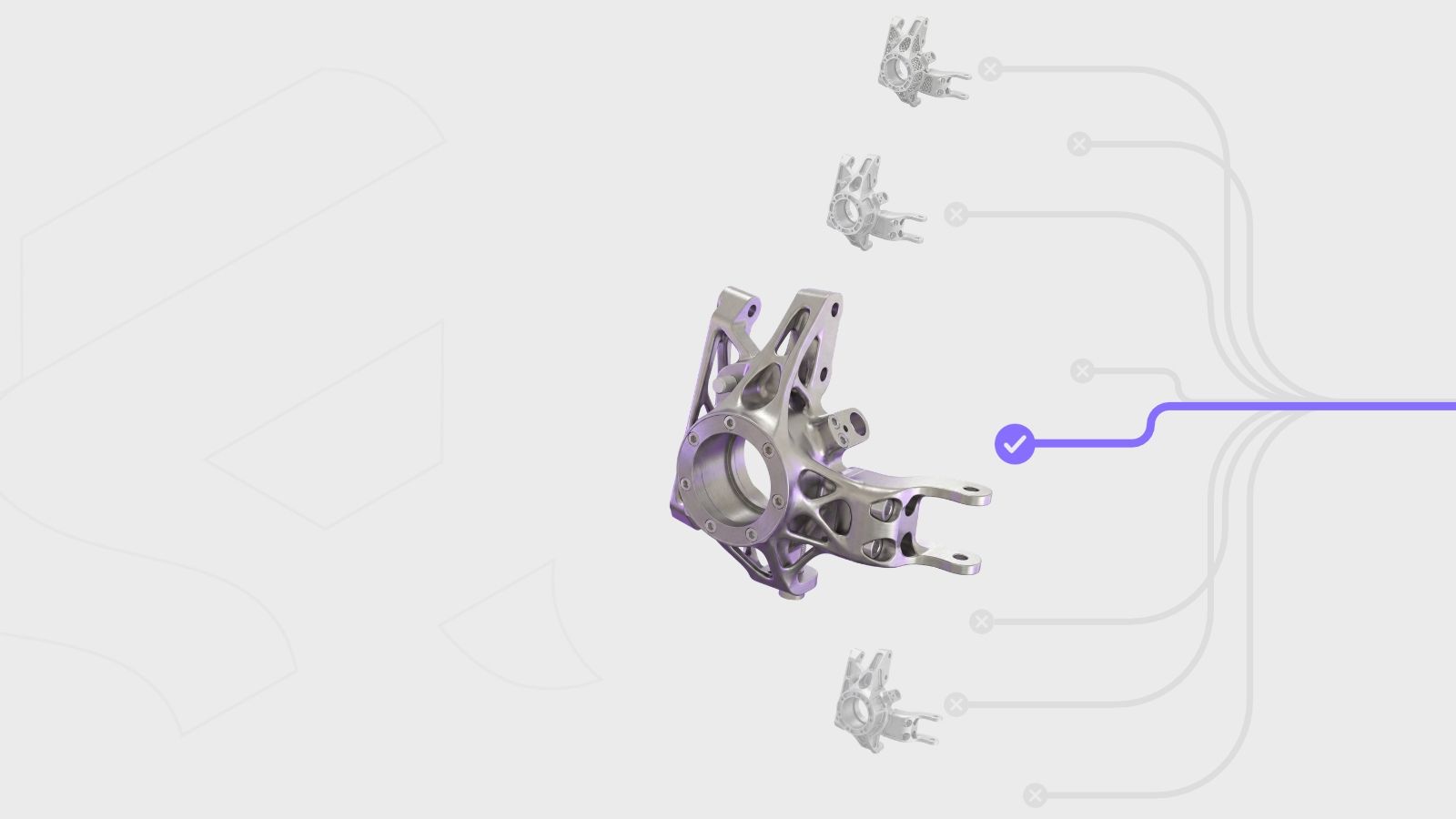
A workflow built for a satellite bracket today can be reused for a structural rib tomorrow and adapted for a casting the week after by swapping its manufacturing constraint set while the rest of the logic carries over. Each reuse costs a fraction of the original build, and each adaptation makes the workflow more robust.
The published results illustrate this effect. Thales Alenia Space applied one workflow across 80+ tripod variants, achieving a 45% average mass reduction per part and a 50% reduction in total lead time across the family. On a hybrid vehicle gearbox housing, embedding casting constraints in the workflow reduced design time from 124 hours to 12 hours, with zero manual DFM iteration cycles.
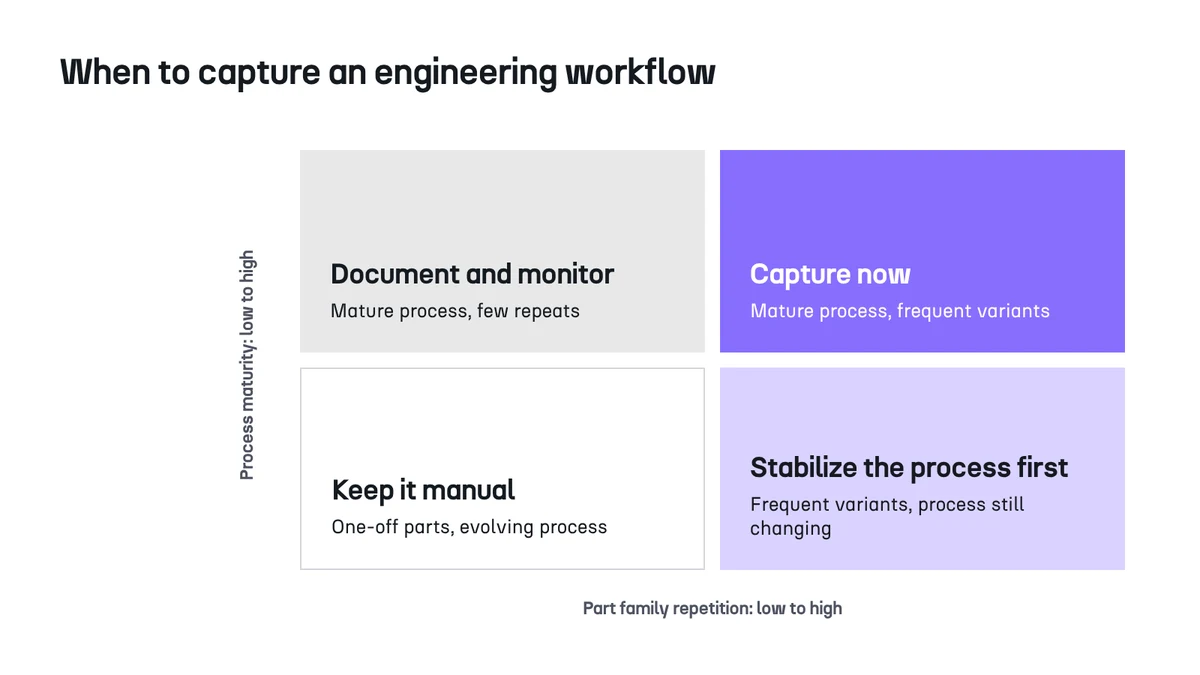
Workflow capture pays off when a design problem repeats with variations, and when the process behind it is mature enough to be trusted. When either condition is missing, the time spent encoding the workflow is unlikely to be recovered through reuse, and a lighter approach, such as a documented review checklist or a one-off study, answers the need more directly.
Three situations call for a different approach:
The most significant trade-off is time, because building a robust workflow requires several days of the best engineers' attention at exactly the moment they are most in demand. Teams that skip this investment, or delegate it to junior staff without review, often produce templates that nobody trusts.
A pragmatic rule is to start with the part family that combines the highest repetition and the most experienced owner, ideally before that owner leaves, and to validate the first workflow against a part already in service.
Cognitive Design, the concept exploration software developed by CDS, records each design chain as a node-based parametric workflow covering design space definition, topology optimization, manufacturing-driven design, simulation-driven design and validation. A new variant is generated by changing the input geometry and boundary conditions, and the full chain recomputes without rebuilding the optimization logic, so the expert's sequence of decisions is replayed rather than reconstructed.
The same workflow can be stored, duplicated and shared as a file, so the logic of one expert becomes available to the rest of the team.
Exploration results remain in the Design Explorer with the criteria used to compare them, which keeps the reasons for rejecting a concept attached to the decision. In CDS deployments, the concept retained at the end of exploration is typically 95% similar to the final part. More detail is available on the reusable workflows page.
The best engineers of the next decade will not be judged solely on what they personally know or produce, but also on the quality of the workflows they leave behind. Engineering excellence is evolving from individual craft toward institutional design intelligence, a shift that is redefining the mechanical engineer's role without making the craft any less important, since a workflow can only encode what the craft has first worked out.
An engineer who solves a problem once adds value once; an engineer who encodes the solution as a workflow adds value on every program that follows.
When an organization cannot answer whether its knowledge stays after its best people leave, the problem is not talent but architecture, and architecture is something engineering leaders can change.
The guide to reusable engineering workflows explains how workflows are structured across part families, the article on design of experiments in the concept phase shows how a captured workflow becomes an exploration plan, and the Thales Alenia Space case study documents a workflow applied across an entire bracket family.
Explore our frequently asked questions to understand how our software can benefit you.
Engineering knowledge capture is the practice of preserving the know-how behind a design so the organization can reuse it after the original engineer moves on. It goes beyond archiving CAD and simulation files by encoding the decision logic, constraints, and validation criteria that produced a reliable result.
Tacit knowledge is personal intuition built over years, and it can only be partly transferred through mentoring. Process knowledge is the structured sequence of decisions, constraints, and checks an expert applies, and it can be encoded in a reusable workflow that other engineers run.
PLM systems version geometry and manage configurations, but they do not store the logic that produced a design as an executable asset. The sequence of optimization steps, manufacturing rules, and validation thresholds usually remains in documents or in the engineer's memory.
Workflow amnesia is the systematic loss of engineering decision logic that occurs when a project ends, a team restructures, or a senior engineer leaves. It happens because legacy CAD and PLM systems version geometry and configuration, but never version the reasoning behind a design decision.
A reusable workflow contains the design space, load cases, material properties, manufacturing constraints, optimization targets, and validation thresholds, together with the order in which they apply. It also separates exposed parameters that users can change from locked rules that must remain fixed.
Most life-cycle cost is committed during early design, so expert knowledge has the most impact there. A captured workflow keeps every explored concept inside an expert-defined design space and records why options were rejected, which prevents future programs from repeating the same dead ends.
Reusable workflows do not replace hiring, but they let new engineers apply validated expert logic from their first project. This shortens onboarding and protects the organization when experienced engineers retire or change jobs.
A workflow does not certify a part, but it supports the traceability that certification requires. Because the same inputs, rules, and validation criteria are applied every time, the team can document how each variant was designed and checked.

Request a demo to see how Cognitive Design by CDS can revolutionize your engineering workflow